Here's an interesting article via IH Tribune that argues against the conventional wisdom that market liberalism leads to democracy. It presents a theory of how modern autocrats successfully side-step democratization while reaping / spreading the benefits of economic growth, which perversely serves to strengthen their autocracy. The article is a sneak preview of the detailed version in next month's Foreign Affairs. A few snippets:
Economic growth has traditionally been thought to promote democratization by making strategic coordination easier, as communications technology improves, news media become more diverse and the citizenry more educated. But in recent years some savvy regimes have learned how to cut the cord between growth and strategic coordination, allowing the former without having to worry about the latter.
Their trick is to ration carefully the subset of public goods that facilitate political coordination, while investing in others that are essential to economic growth. The "coordination goods" that they need to worry about consist of things such as political and civil rights, press freedom and access to higher education. "Standard public goods" include public transportation, primary and secondary education, and public health; all of which contribute to economic growth and pose relatively little threat to the regime.
This provides fresh insights into the reasons for the continued longevity of the Chinese and Pakistani regimes, in our neighborhood, among a long list of other accomplished autocrats worldwide. Seems like business is the new gladiatorial-bloodsport and the stock exchange is the new Colosseum. To quote from the recent hit movie Gladiator:
I think he knows what Rome is. Rome is the mob. Conjure magic for them and they'll be distracted. Take away their freedom and still they'll roar. The beating heart of Rome is not the marble of the senate, it's the sand of the coliseum. He'll bring them death - and they will love him for it.
This is a disheartening article for those looking for practical tools to fight autocracies. It calls for a re-think of the engagement strategy, whether U.S. with China / Mideast or India with Pakistan. At a minimum, it requires abandoning the naive hope that economic and cultural engagement will somehow auto-magically transform autocracies. We need to find new levers to push for rights and liberties that ought to be self-evident truths everywhere. We need to push for this, if not for their peoples' sake, then for our own, as Sep 11 and Dec 13 showed all too well the consequences of not doing so.
Monday, August 22, 2005


Shariat
Via Times of India, Muslim law board tones down stand on imposing Shariat on India's judicial system. Apparently, this is a tactical retreat, not the abandonment of a rather controversial idea.
We have two questions on this issue.
Isn't Shariat the reason why non-Muslim Indians are denied prayer in Saudi Arabia?
What happens when Shariat comes in conflict with India's constitution?
Hopefully this is crystal clear to all. In India, the constitution must trump all else. Any denial of our constitutionally guaranteed freedoms and equality (even in a civil context) in the name of any faith is invalid. This is the only possible secular position -- supporters of Shariat in Indian courts better be real careful lest they pick a bruising battle with secular Indians.
We have two questions on this issue.
Isn't Shariat the reason why non-Muslim Indians are denied prayer in Saudi Arabia?
What happens when Shariat comes in conflict with India's constitution?
Hopefully this is crystal clear to all. In India, the constitution must trump all else. Any denial of our constitutionally guaranteed freedoms and equality (even in a civil context) in the name of any faith is invalid. This is the only possible secular position -- supporters of Shariat in Indian courts better be real careful lest they pick a bruising battle with secular Indians.
Dr. Singh And Naxals
Indian Express hails Dr. Singh's call that Naxals prove their popularity through the test of democracy.
We like Dr. Singh and his call sounds reasonable but it reflects an enduring naivete of the Indian soul -- that even such rabid killers as the Naxals can be rehabilitated in the broader sweep of our all-embracing democracy.
We strongly dissent with this view. Only smash-mouth strategies work with these monsters. They don't care about our democracy -- they've got a mafia-like extortion racket working that brings them money, guns, publicity, criminal power, and other very material things. If they were to settle their so-called grudges, where does it leave them and the elaborate terrorist lives they've built for themselves?
Dr. Singh, pick up the gun -- please quit exhorting these animals to become human.
We like Dr. Singh and his call sounds reasonable but it reflects an enduring naivete of the Indian soul -- that even such rabid killers as the Naxals can be rehabilitated in the broader sweep of our all-embracing democracy.
We strongly dissent with this view. Only smash-mouth strategies work with these monsters. They don't care about our democracy -- they've got a mafia-like extortion racket working that brings them money, guns, publicity, criminal power, and other very material things. If they were to settle their so-called grudges, where does it leave them and the elaborate terrorist lives they've built for themselves?
Dr. Singh, pick up the gun -- please quit exhorting these animals to become human.
Gaza
The New Yorker's editor David Remnick writes cogently about Israel's Getting Out of Gaza.
He correctly concludes:
In the nineteen-nineties, the era of the Oslo accords, a dream persisted of imminent peace—a state for the Palestinians, security and recognition for the Israelis. The Gaza disengagement makes plain the distance between that dream and its reality, and how traumatic it is to conduct earthly politics where so much is sacred to so many.
He correctly concludes:
In the nineteen-nineties, the era of the Oslo accords, a dream persisted of imminent peace—a state for the Palestinians, security and recognition for the Israelis. The Gaza disengagement makes plain the distance between that dream and its reality, and how traumatic it is to conduct earthly politics where so much is sacred to so many.
India And Stem Cell Research
Via New York Times, How India Reconciles Hindu Values and Biotech.
Novelist Pankaj Mishra writes:
Scientism has few detractors in India; and the elites find it easy to propose technological rather than political and moral solutions to the problems of poverty, inequality and environmental damage ... They subscribe to a worldly form of Hinduism - one that now proves to be infinitely adjustable to the modern era, endorsing nuclear bombs and biotechnology as well as India's claim to be taken seriously as an emerging economic and scientific superpower.
Mr. Mishra doesn't really address his subject line. In fact, as he sees it, Indians don't reconcile Hindu values and Biotech at all -- instead, they abandon Hindu values to pursue technology. This is a ridiculous perspective by an author seemingly grasping for cheap publicity by damning his own people.
Novelist Pankaj Mishra writes:
Scientism has few detractors in India; and the elites find it easy to propose technological rather than political and moral solutions to the problems of poverty, inequality and environmental damage ... They subscribe to a worldly form of Hinduism - one that now proves to be infinitely adjustable to the modern era, endorsing nuclear bombs and biotechnology as well as India's claim to be taken seriously as an emerging economic and scientific superpower.
Mr. Mishra doesn't really address his subject line. In fact, as he sees it, Indians don't reconcile Hindu values and Biotech at all -- instead, they abandon Hindu values to pursue technology. This is a ridiculous perspective by an author seemingly grasping for cheap publicity by damning his own people.
Saturday, August 20, 2005
Et Tu, Rezwan?
Recently, Rezwan accused us unfairly of generalizing our hatred for Muslims. He wrote:
You people can't get this thing off your head. There is no Islamist terrorism. There is terrorism of some f***ed up Islamists in the name of Islam.
In other words, he objected to our attaching the tag Islamist (not Muslim, not Islamic -- but Islamist) to the word terrorism.
We answered the charge and moved on. Then, much to our surprise, we read this in his recent post on the Bangladeshi bombings:
All the evidences and confessions of some nabbed terrorists point at the banned Islamic extremist Jama'atul Mujahideen Bangladesh (JMB), who carried out Wednesday's countrywide bombings.
So, it's OK for Rezwan to use the tag Islamic to describe these monsters, but it isn't for us to tag their terrorist soulmates outside Bangladesh with a more precise tag, Islamist? Hmmm.
You people can't get this thing off your head. There is no Islamist terrorism. There is terrorism of some f***ed up Islamists in the name of Islam.
In other words, he objected to our attaching the tag Islamist (not Muslim, not Islamic -- but Islamist) to the word terrorism.
We answered the charge and moved on. Then, much to our surprise, we read this in his recent post on the Bangladeshi bombings:
All the evidences and confessions of some nabbed terrorists point at the banned Islamic extremist Jama'atul Mujahideen Bangladesh (JMB), who carried out Wednesday's countrywide bombings.
So, it's OK for Rezwan to use the tag Islamic to describe these monsters, but it isn't for us to tag their terrorist soulmates outside Bangladesh with a more precise tag, Islamist? Hmmm.
Violins In Kalimpong
Fred de Sam Lazaro of American public television (PBS) reports on a really cool musical experiment in Kalimpong. Here, a Jesuit priest, gave violins and lessons to poor kids and watched them find joy from their own talents.
Take Kushmita, for example. As a poor kid having been accepted at an upscale convent, she faced typical challenges of peer acceptance and fitting in. This is what she tells Mr. Lazaro:
KUSHMITA BISWA KARMA: I used to play violin. I used to play solo songs, like Hindi, Nepali songs. And they all used to love me playing violin. I had friends. Many friends I had in the convent.
FRED DE SAM LAZARO: So you had many friends in the convent school because you were able to play violin?
KUSHMITA BISWA KARMA: And I was good, also.
FRED DE SAM LAZARO: She's good at the violin-- so good she was pulled out of school to be tutored by a visiting German music teacher in hopes of attending one of Germany's most prestigious conservatories.
KUSHMITA BISWA KARMA: Before, I didn't know, like, the rules and the way... how we should play violin. She taught me how I should hold my bows and how should I cast the violin. I want to come back to Kalimpong because my parents are here. I was born here. I studied in Gandhi Ashram School in Kalimpong.
Father Thomas McGuire of Gandhi Ashram died recently. What a beautiful legacy he's left behind. Very cool!
Take Kushmita, for example. As a poor kid having been accepted at an upscale convent, she faced typical challenges of peer acceptance and fitting in. This is what she tells Mr. Lazaro:
KUSHMITA BISWA KARMA: I used to play violin. I used to play solo songs, like Hindi, Nepali songs. And they all used to love me playing violin. I had friends. Many friends I had in the convent.
FRED DE SAM LAZARO: So you had many friends in the convent school because you were able to play violin?
KUSHMITA BISWA KARMA: And I was good, also.
FRED DE SAM LAZARO: She's good at the violin-- so good she was pulled out of school to be tutored by a visiting German music teacher in hopes of attending one of Germany's most prestigious conservatories.
KUSHMITA BISWA KARMA: Before, I didn't know, like, the rules and the way... how we should play violin. She taught me how I should hold my bows and how should I cast the violin. I want to come back to Kalimpong because my parents are here. I was born here. I studied in Gandhi Ashram School in Kalimpong.
Father Thomas McGuire of Gandhi Ashram died recently. What a beautiful legacy he's left behind. Very cool!
Rural Wi-Fi
Via Christian Science Monitor, India bypasses the wires to bring Wi-Fi to its remote residents.
Good stuff. Yet, some think this is wasteful expenditure.
The biggest challenge may not be technological, but linguistic, and developing services that give rural communities reasons to use the Internet. In Malappuram, for example, a study by professors at the University of California, Berkeley, found that just 5 percent of the traffic from the Akshaya centers related to e-governance or education. Some experts on rural technology, like Anil Gupta, a professor at the Indian Institute of Management, Ahmedabad, question whether the Internet should be a priority, if people don't speak English.
"We find that the Internet is not the technology [through] which we will reach villages in the country in the next five years," Dr. Gupta says. "Look up Google and find the content we have in local languages.... Unless that happens, how can we justify what we are doing?"
We're not sure this is a valid fuss. Even if 95% of internet traffic is not e-governance or education related, it's still a valid interaction our rural folks can now have with the rest of the world. What could possibly be wrong with this?
Good stuff. Yet, some think this is wasteful expenditure.
The biggest challenge may not be technological, but linguistic, and developing services that give rural communities reasons to use the Internet. In Malappuram, for example, a study by professors at the University of California, Berkeley, found that just 5 percent of the traffic from the Akshaya centers related to e-governance or education. Some experts on rural technology, like Anil Gupta, a professor at the Indian Institute of Management, Ahmedabad, question whether the Internet should be a priority, if people don't speak English.
"We find that the Internet is not the technology [through] which we will reach villages in the country in the next five years," Dr. Gupta says. "Look up Google and find the content we have in local languages.... Unless that happens, how can we justify what we are doing?"
We're not sure this is a valid fuss. Even if 95% of internet traffic is not e-governance or education related, it's still a valid interaction our rural folks can now have with the rest of the world. What could possibly be wrong with this?
Thursday, August 18, 2005
The Nature Of Defeatism
Via The American Thinker, the conservative Lawrence Auster mocks the Bush Revolution :
Bush turned a set of rights long established in America and for Americans into a requirement for all of humanity. It wasn't just that we regarded the enumerated rights as self-evidently true. It was that we regarded their practical establishment in the whole world and particularly in the Muslim lands as, first, a non-negotiable moral demand, and, second, as the only way to assure a world safe from terrorism. There was a specious logic in the latter argument that passed for great wisdom in some quarters. The past policy of cooperating with Arab and Muslim dictatorships hadn't prevented the growth of Muslim extremism. Therefore we had to try the opposite tack, of democratizing the Muslim countries.
In New York Times, Foreign Affairs editor Gideon Rose chimes in:
The Bush doctrine has collapsed, and the administration has consequently embraced realism, American foreign policy's perennial hangover cure.
What explains this utterly absurd defeatism?
Two independent dynamics have collided here to create a very dangerous confusion in some minds. On the one hand, there is terrorism spewing out of paleo-political ideologies pretending to be Islam. On the other, there is American hyper-power status. How people weigh the threat from each versus the other determines where they stand on this war.
Most sensible people understand that whether or not we wage war on terrorists, terrorists will wage unrelenting war on us. Therefore, the only valid course is to take war to where it spews from -- regardless of the short-term cost.
There's, in opposition, a sizable & amusing coalition of isolationists, pacifists, naive liberals, and some Muslims who feel that waging war on terrorists only provokes them further. Instead, they argue, civilized world should essentially concede even illegitimate terrorist demands (really clever excuses for their murderous nature) to avert future attacks.
Finally, and crucially, there are many (especially on the left) who are appalled at the present dominance of the world by America and her allies. They are enraged by American leadership of the war on terror not because this is a war on terror but that it is an American-led war. They'd rather see America retreat even if it means continued life for terrorism.
This is also the view of some Americans who see the war on terror as the building blocks of an American empire. To them, the war against terror (and more generally, the war against local disorder with global impact) is really an excuse to re-design the global order where a handful of great powers dictate policy to everyone else. This they cannot stand.
The exact same fear offends many in the developing world whose memories of colonialism are still fresh.
Consequently, there's a faux-romantic tendency to see all manner of frivolous and damaging claims against even democratic great powers as being valid root-causes, the paralyzing and paralyzed UN as a noble entity, dictatorships and corruption as matters of sovereignty and, worst of all, terrorists as freedom fighters and insurgents.
This is the nature of the defeatism in our midst -- the terrorists understand and exploit this quite well. It is up to democratic societies to find the steel in their character to resist this devilish exploitation and stay the course on an entirely just and necessary war of survival.
Bush turned a set of rights long established in America and for Americans into a requirement for all of humanity. It wasn't just that we regarded the enumerated rights as self-evidently true. It was that we regarded their practical establishment in the whole world and particularly in the Muslim lands as, first, a non-negotiable moral demand, and, second, as the only way to assure a world safe from terrorism. There was a specious logic in the latter argument that passed for great wisdom in some quarters. The past policy of cooperating with Arab and Muslim dictatorships hadn't prevented the growth of Muslim extremism. Therefore we had to try the opposite tack, of democratizing the Muslim countries.
In New York Times, Foreign Affairs editor Gideon Rose chimes in:
The Bush doctrine has collapsed, and the administration has consequently embraced realism, American foreign policy's perennial hangover cure.
What explains this utterly absurd defeatism?
Two independent dynamics have collided here to create a very dangerous confusion in some minds. On the one hand, there is terrorism spewing out of paleo-political ideologies pretending to be Islam. On the other, there is American hyper-power status. How people weigh the threat from each versus the other determines where they stand on this war.
Most sensible people understand that whether or not we wage war on terrorists, terrorists will wage unrelenting war on us. Therefore, the only valid course is to take war to where it spews from -- regardless of the short-term cost.
There's, in opposition, a sizable & amusing coalition of isolationists, pacifists, naive liberals, and some Muslims who feel that waging war on terrorists only provokes them further. Instead, they argue, civilized world should essentially concede even illegitimate terrorist demands (really clever excuses for their murderous nature) to avert future attacks.
Finally, and crucially, there are many (especially on the left) who are appalled at the present dominance of the world by America and her allies. They are enraged by American leadership of the war on terror not because this is a war on terror but that it is an American-led war. They'd rather see America retreat even if it means continued life for terrorism.
This is also the view of some Americans who see the war on terror as the building blocks of an American empire. To them, the war against terror (and more generally, the war against local disorder with global impact) is really an excuse to re-design the global order where a handful of great powers dictate policy to everyone else. This they cannot stand.
The exact same fear offends many in the developing world whose memories of colonialism are still fresh.
Consequently, there's a faux-romantic tendency to see all manner of frivolous and damaging claims against even democratic great powers as being valid root-causes, the paralyzing and paralyzed UN as a noble entity, dictatorships and corruption as matters of sovereignty and, worst of all, terrorists as freedom fighters and insurgents.
This is the nature of the defeatism in our midst -- the terrorists understand and exploit this quite well. It is up to democratic societies to find the steel in their character to resist this devilish exploitation and stay the course on an entirely just and necessary war of survival.
Wednesday, August 17, 2005
Bangladesh Bombings
Via BBC, Bombs explode across Bangladesh .
Perhaps the root-cause crowd would like to explain what Israeli, Indian, or American crime lies behind this terror directed at ordinary Muslims in Bangladesh?
Hopefully it will soon dawn on these naive terror-apologists that terrorists seek no political goals -- rather, they only seek murder and mayhem, because they only know murder and mayhem.
Perhaps the root-cause crowd would like to explain what Israeli, Indian, or American crime lies behind this terror directed at ordinary Muslims in Bangladesh?
Hopefully it will soon dawn on these naive terror-apologists that terrorists seek no political goals -- rather, they only seek murder and mayhem, because they only know murder and mayhem.
Charitable Deductions
Why is it that in India one only gets to deduct 50% of any charitable deductions for tax purposes?
In America, in contrast, one gets to deduct 100% -- this is a terrific way to incentivize charitable giving to fund a whole range of non-governmental social programs.
Isn't it time Indians had the same benefit?
In America, in contrast, one gets to deduct 100% -- this is a terrific way to incentivize charitable giving to fund a whole range of non-governmental social programs.
Isn't it time Indians had the same benefit?
Monday, August 15, 2005
The Greatest Trick
In the film noir classic The Usual Suspects, Kevin Spacey's character reprises Baudelaire to describe the genius of the arch-villain Keyser Soze: The greatest trick the Devil ever pulled was convincing the world he didn't exist.
Having read this NRO review of National Geographic's Inside 9/11, we are compelled to reprise the same idea in a different context: The greatest trick Kashmiri separatists ever pulled was convincing the world India oppresses them.
How else can we explain the following lumping together of democratic India with autocratic Russia & China by Michael Scheuer (ex-CIA, responsible for hunting down bin Laden):
The beginning of winning this war is for the president to tell the American people that the motivation behind our enemy's actions has to do with our actions in the Islamic world, not who we are ... Our unqualified support for Israel, our ability until recently to keep oil prices low, our occupation of the three holiest places in Islam (the Arabian peninsula, Iraq, and Jerusalem), our support for countries that oppress Muslims (China, India, Russia), our support of Arab police states over the last 30 years in Saudi Arabia, in Jordan, Algeria, Egypt.
Then, the (rightfully skeptical) reviewer Catherine Seipp retorts with this helpful (!) stunner:
China, India and Russia may oppress Muslims, but not compared to Muslim countries like Iraq under Saddam Hussein, which for some reason al Qaeda never complained about.
Hello?! India oppresses Muslims? How in God's name have we let this absurd impression to gain ground? The answer is not hard to find. It is our ridiculous liberal defensiveness about Kashmir that's caused this. The day India proudly asserts its moral validity to rule Kashmir is the day we can begin correcting this horribly erroneous record.
Having read this NRO review of National Geographic's Inside 9/11, we are compelled to reprise the same idea in a different context: The greatest trick Kashmiri separatists ever pulled was convincing the world India oppresses them.
How else can we explain the following lumping together of democratic India with autocratic Russia & China by Michael Scheuer (ex-CIA, responsible for hunting down bin Laden):
The beginning of winning this war is for the president to tell the American people that the motivation behind our enemy's actions has to do with our actions in the Islamic world, not who we are ... Our unqualified support for Israel, our ability until recently to keep oil prices low, our occupation of the three holiest places in Islam (the Arabian peninsula, Iraq, and Jerusalem), our support for countries that oppress Muslims (China, India, Russia), our support of Arab police states over the last 30 years in Saudi Arabia, in Jordan, Algeria, Egypt.
Then, the (rightfully skeptical) reviewer Catherine Seipp retorts with this helpful (!) stunner:
China, India and Russia may oppress Muslims, but not compared to Muslim countries like Iraq under Saddam Hussein, which for some reason al Qaeda never complained about.
Hello?! India oppresses Muslims? How in God's name have we let this absurd impression to gain ground? The answer is not hard to find. It is our ridiculous liberal defensiveness about Kashmir that's caused this. The day India proudly asserts its moral validity to rule Kashmir is the day we can begin correcting this horribly erroneous record.
August 15
Given little to inspire us, we think it appropriate to mark this August 15 without comment.
Sunday, August 14, 2005
G4's Quest Is Over
Via New York Times, German Chancellor Schroeder Rejects Military Force to Stop Iran's Nuclear Work.
This came in response to this report: `All options on table,' as Bush warns Iran on nuclear program. [Link courtesy: Chicago Tribune]
While Chancellor's Schroeder's comments came as part of his re-election campaign -- to woo an electorate deeply suspicious of the Iraq war -- it also signals clearly that Germany will not get US assent for Security Council membership. The Chancellor would not have risked UNSC membership -- his legacy in history -- for scoring a cheap political point.
This implies that the G4 effort is effectively dead. Hardly a surprise.
This came in response to this report: `All options on table,' as Bush warns Iran on nuclear program. [Link courtesy: Chicago Tribune]
While Chancellor's Schroeder's comments came as part of his re-election campaign -- to woo an electorate deeply suspicious of the Iraq war -- it also signals clearly that Germany will not get US assent for Security Council membership. The Chancellor would not have risked UNSC membership -- his legacy in history -- for scoring a cheap political point.
This implies that the G4 effort is effectively dead. Hardly a surprise.
Saturday, August 13, 2005
An Ominous Report
Israeli website Debka carries this very disturbing story. Time to steel ourselves, again.
DEBKAfile’s counter-terror sources register a volume and heightened sense of anticipation in al Qaeda’s internal communications, signals, publications and Websites - mostly in code - that recall its electronic traffic in the months leading up to the Sept. 11, 2001 attacks. The sense of a big anti-American event in the making for September-October is marked. Self-congratulatory accounts of the London and Sharm al Sheikh July bombings abound, along with extravagant claims of victories against American forces in Iraq.
This surge of activity, electronic and human, seems to signpost an al Qaeda offensive in the works, and will no doubt raise terror threat levels in US, European and Middle East cities in the coming weeks.
DEBKAfile’s counter-terror sources register a volume and heightened sense of anticipation in al Qaeda’s internal communications, signals, publications and Websites - mostly in code - that recall its electronic traffic in the months leading up to the Sept. 11, 2001 attacks. The sense of a big anti-American event in the making for September-October is marked. Self-congratulatory accounts of the London and Sharm al Sheikh July bombings abound, along with extravagant claims of victories against American forces in Iraq.
This surge of activity, electronic and human, seems to signpost an al Qaeda offensive in the works, and will no doubt raise terror threat levels in US, European and Middle East cities in the coming weeks.
The Theology Of Global Warming
In The Wall Street Journal, James Schlesinger argues that the theology of global warming is based on politics, not science.
He writes:
The issue of climate change urgently needs to be brought down from the level of theology to what we actually know. It is, of course, quite likely that the greenhouse effect has to some extent contributed to global warming--but we simply do not know to what extent. The insistence that global warming is primarily the consequence of human activity leaves scant room for variation in solar intensity or cyclical phenomena generally.
Over the ages, climate has varied. Generally speaking, the Northern Hemisphere has been warming since the end of the Little Ice Age in the 17th century. Most of the global warming observed in the 20th century occurred between 1900 and 1940, when the release of greenhouse gasses was far less than later in the century. Between 1940 and 1975, temperatures fell--and scientists feared a lengthy period of global cooling. The reported rise in temperatures in recent decades has come rather suddenly--probably too suddenly given the relatively slow rise of greenhouse gases in the atmosphere.
We must always bear in mind that the earth's atmosphere remains a highly complex thermodynamic machine. Given its complexities, we need to be modest in asserting what we know. Knowledge is more than speculation.
He writes:
The issue of climate change urgently needs to be brought down from the level of theology to what we actually know. It is, of course, quite likely that the greenhouse effect has to some extent contributed to global warming--but we simply do not know to what extent. The insistence that global warming is primarily the consequence of human activity leaves scant room for variation in solar intensity or cyclical phenomena generally.
Over the ages, climate has varied. Generally speaking, the Northern Hemisphere has been warming since the end of the Little Ice Age in the 17th century. Most of the global warming observed in the 20th century occurred between 1900 and 1940, when the release of greenhouse gasses was far less than later in the century. Between 1940 and 1975, temperatures fell--and scientists feared a lengthy period of global cooling. The reported rise in temperatures in recent decades has come rather suddenly--probably too suddenly given the relatively slow rise of greenhouse gases in the atmosphere.
We must always bear in mind that the earth's atmosphere remains a highly complex thermodynamic machine. Given its complexities, we need to be modest in asserting what we know. Knowledge is more than speculation.
The Nature Of War
From Auden:
I sit in one of the dives
On Fifty-second Street
Uncertain and afraid
As the clever hopes expire
Of a low dishonest decade.
We suspect that the 90s will go down as a false start for our inter-connected world; the wars that have followed and are yet to come are the wages of our decade-long (liberalism-laced) celebration of the fall of communist Moscow.
While we partied, the merchants of death plotted. While we booked unearned capital gains, terrorist hyenas (paraphrasing Eliot) laughed without mirth. They even read Orwell and excelled in doublespeak -- suicide bombings and nationalism obscenely became linked.
This evil wave crested on 9/11. All tides (even tsunamis) eventually turn back -- or are held back by determined and sensible people of goodwill.
This is the nature of the war we are in. The shrieking left and cynical terror apologists either don't get it or get it but don't care. Either way, they stand in the way of defeating the evil shadow of terror in our world.
I sit in one of the dives
On Fifty-second Street
Uncertain and afraid
As the clever hopes expire
Of a low dishonest decade.
We suspect that the 90s will go down as a false start for our inter-connected world; the wars that have followed and are yet to come are the wages of our decade-long (liberalism-laced) celebration of the fall of communist Moscow.
While we partied, the merchants of death plotted. While we booked unearned capital gains, terrorist hyenas (paraphrasing Eliot) laughed without mirth. They even read Orwell and excelled in doublespeak -- suicide bombings and nationalism obscenely became linked.
This evil wave crested on 9/11. All tides (even tsunamis) eventually turn back -- or are held back by determined and sensible people of goodwill.
This is the nature of the war we are in. The shrieking left and cynical terror apologists either don't get it or get it but don't care. Either way, they stand in the way of defeating the evil shadow of terror in our world.
Drugs In Sports
Why do we read so many embarrassing reports like this one from BBC: Discus thrower fails drugs test ?
Indian discus thrower Neelam Jaswant Singh is the first athlete to test positive at the World Championships ... Singh managed a best throw of 56.70m in Helsinki and failed to qualify for the discus final.
What a singular disgrace. How come India has ended up inheriting the East European practice of drugs-abetted cheating in sports?
Indian discus thrower Neelam Jaswant Singh is the first athlete to test positive at the World Championships ... Singh managed a best throw of 56.70m in Helsinki and failed to qualify for the discus final.
What a singular disgrace. How come India has ended up inheriting the East European practice of drugs-abetted cheating in sports?
Like PLO With Arafat
BBC reports: Peace fears as Sri Lanka mourns Lakshman Kadirgamar.
Another fateful assassination has struck at the heart of Sri Lanka's establishment. Suddenly, people are expressing fear that the peace process might come unglued.
Peace process?
There is no peace process with terrorists. Why is it that the world does not understand this basic reality? Terrorists have no political ends, notwithstanding their pious claims of nationalist struggle. All they seek is murder -- because all they know is murder.
Let's please stop characterizing cold-blooded murder as politics by other means. Those who do, the root-cause crowd, cannot evade personal and moral complicity in encouraging these fanatic killers.
We learnt this in Palestine, where Yasser Arafat's PLO remained a terrorist organization all through the so-called peace process. When, in 2000 in Taba, it was offered a deal as good as any possible, it turned it down. In so doing, it demonstrated that the needs of Palestine's long-suffering people was not the issue for Mr. Arafat -- indeed, he needed such suffering to continue so that he would have a convenient cause to sustain his criminal-terrorist enterprise (one that made him a very wealthy man even as Palestine withered).
No peace process was possible, we finally understood, until Mr. Arafat was dead. Mercifully, his demise came sooner than later.
The same is true with LTTE; Pirbhakaran is like Arafat. Only upon his passing (or incarceration for hard-life in Tihar) can the Jaffna Tamils participate in ending Sri Lanka's long national nightmare. Since he has prevented the rise of natural successors, the LTTE will blessedly die with Pirbhakaran.
And, while we await Pirbhakaran's (hopefully excruciating) passing, the Jaffna Tamils need to be clearly told that there's no pot of Eelam at the end of LTTE's violent rainbow. India -- the uber-power in the region -- will not accept any devolution of power to Tamils, unless LTTE is out of the picture. This position should not be up for any negotiation. If Jaffna Tamils prefer the LTTE to civilized negotiation, well then, they are welcome to remain frozen in their little corner of Tiger hell -- no one will come to help them out.
[Note to the "we must examine the root-cause of terror" crowd: Please notice the clarity of this Hindu blogger's denunciation of Hindu terror in Sri Lanka -- something for you all to ponder.]
Another fateful assassination has struck at the heart of Sri Lanka's establishment. Suddenly, people are expressing fear that the peace process might come unglued.
Peace process?
There is no peace process with terrorists. Why is it that the world does not understand this basic reality? Terrorists have no political ends, notwithstanding their pious claims of nationalist struggle. All they seek is murder -- because all they know is murder.
Let's please stop characterizing cold-blooded murder as politics by other means. Those who do, the root-cause crowd, cannot evade personal and moral complicity in encouraging these fanatic killers.
We learnt this in Palestine, where Yasser Arafat's PLO remained a terrorist organization all through the so-called peace process. When, in 2000 in Taba, it was offered a deal as good as any possible, it turned it down. In so doing, it demonstrated that the needs of Palestine's long-suffering people was not the issue for Mr. Arafat -- indeed, he needed such suffering to continue so that he would have a convenient cause to sustain his criminal-terrorist enterprise (one that made him a very wealthy man even as Palestine withered).
No peace process was possible, we finally understood, until Mr. Arafat was dead. Mercifully, his demise came sooner than later.
The same is true with LTTE; Pirbhakaran is like Arafat. Only upon his passing (or incarceration for hard-life in Tihar) can the Jaffna Tamils participate in ending Sri Lanka's long national nightmare. Since he has prevented the rise of natural successors, the LTTE will blessedly die with Pirbhakaran.
And, while we await Pirbhakaran's (hopefully excruciating) passing, the Jaffna Tamils need to be clearly told that there's no pot of Eelam at the end of LTTE's violent rainbow. India -- the uber-power in the region -- will not accept any devolution of power to Tamils, unless LTTE is out of the picture. This position should not be up for any negotiation. If Jaffna Tamils prefer the LTTE to civilized negotiation, well then, they are welcome to remain frozen in their little corner of Tiger hell -- no one will come to help them out.
[Note to the "we must examine the root-cause of terror" crowd: Please notice the clarity of this Hindu blogger's denunciation of Hindu terror in Sri Lanka -- something for you all to ponder.]
Revolutions From Tea Parties
Neoconservative icon Norman Podhoretz's son John has this to say on The Corner on National Review Online:
There were so 550 neocons in the 1980s. Take everybody who wrote for Commentary and the Public Interest, add to them the number of people who attended the yearly bashes of the Committee for the Free World, and you're getting pretty close there.
Given subsequent neoconservative success in overturning history, there is much encouragement here our own nascent Project For A Secular-Right India.
There were so 550 neocons in the 1980s. Take everybody who wrote for Commentary and the Public Interest, add to them the number of people who attended the yearly bashes of the Committee for the Free World, and you're getting pretty close there.
Given subsequent neoconservative success in overturning history, there is much encouragement here our own nascent Project For A Secular-Right India.
Thursday, August 11, 2005
My Son, The Fanatic
Via Opinion Journal, here's Salil Tripathi's take on the London terror.
.. several British Asian novelists have been writing about the turbulence within Britain's Muslim community. But while they have been honored, their warnings have gone unheeded. Mr. Kureishi has won the Whitbread Award for "The Buddha of Suburbia." Many of Mr. Rushdie's novels have been nominated for the Booker Prize, which he won in 1982 for "Midnight's Children." Monica Ali was nominated for the Booker Prize in 2003, for "Brick Lane." Nadeem Aslam won the Encore Award this year in London for "Maps for Lost Lovers." (In June he also won an American award, the Kiriyama Prize, which is given to enhance the West's understanding of the East.)
If those novels were read carefully, then the composite picture that emerges today--of disaffected youth finding a new meaning through faith, joining religious groups and following foreign-born preachers, as well as of subterranean misogyny and ostracizing, and even killing those who leave the community by marrying outside the faith--should not have surprised anyone.
.. several British Asian novelists have been writing about the turbulence within Britain's Muslim community. But while they have been honored, their warnings have gone unheeded. Mr. Kureishi has won the Whitbread Award for "The Buddha of Suburbia." Many of Mr. Rushdie's novels have been nominated for the Booker Prize, which he won in 1982 for "Midnight's Children." Monica Ali was nominated for the Booker Prize in 2003, for "Brick Lane." Nadeem Aslam won the Encore Award this year in London for "Maps for Lost Lovers." (In June he also won an American award, the Kiriyama Prize, which is given to enhance the West's understanding of the East.)
If those novels were read carefully, then the composite picture that emerges today--of disaffected youth finding a new meaning through faith, joining religious groups and following foreign-born preachers, as well as of subterranean misogyny and ostracizing, and even killing those who leave the community by marrying outside the faith--should not have surprised anyone.
Evolution, Again
See Kumar's excellent counterpoint to our posts Evolution -- with a small e and Mindless Design It Surely Ain't before that. Here's our humble response.
Kumar writes:
.. even though a number of philosophical positions are consistent with biology, the price of buying consistency via an instrumentalist interpretation of biology is higher for theism-—it amounts to arguing that the biological data are systematically misleading. Perhaps that is the case, but theism’s reliance on an argument from silence is an epistemic vice, not an epistemic virtue.
Kumar writes:
.. even though a number of philosophical positions are consistent with biology, the price of buying consistency via an instrumentalist interpretation of biology is higher for theism-—it amounts to arguing that the biological data are systematically misleading. Perhaps that is the case, but theism’s reliance on an argument from silence is an epistemic vice, not an epistemic virtue.
Wednesday, August 10, 2005
Power Or Poison?
Via Times of India, Will Manmohan Singh step down from PM's post?
The story tells of his immense dejection over finding himself alone on key issues.
Recently, we were speaking to an industrial psychologist about corporate leadership. He said, contrary to conventional wisdom, it is introverts who make the best CEOs. Why, we asked? Because, he said, in the most difficult decisions with large implications, the CEO is all alone. He needs to be comfortable in his solitude -- something that comes naturally to introverts.
We think he was on to something here. The same applies, we think, to leadership of nations.
Of course, it's real hard to get elected as an introvert. For those who do emerge from the gruelling and uber-social election process, the consequent leadership is less power, more poison -- the demands of their dream job conspiring against their very nature.
We had thought Dr. Singh might be different -- a soft spoken academic, his years of solitary reading may have better prepared him for the rigors of leadership. Now we know that was a false hope. This is bad news for India.
The story tells of his immense dejection over finding himself alone on key issues.
Recently, we were speaking to an industrial psychologist about corporate leadership. He said, contrary to conventional wisdom, it is introverts who make the best CEOs. Why, we asked? Because, he said, in the most difficult decisions with large implications, the CEO is all alone. He needs to be comfortable in his solitude -- something that comes naturally to introverts.
We think he was on to something here. The same applies, we think, to leadership of nations.
Of course, it's real hard to get elected as an introvert. For those who do emerge from the gruelling and uber-social election process, the consequent leadership is less power, more poison -- the demands of their dream job conspiring against their very nature.
We had thought Dr. Singh might be different -- a soft spoken academic, his years of solitary reading may have better prepared him for the rigors of leadership. Now we know that was a false hope. This is bad news for India.
Tuesday, August 09, 2005
The Writer's Spoken Words
Amit links to a New York Times interview with V S Naipaul where the maestro makes a series of typically astonishing assertions.
Is it just us or is Mr. Naipaul's inking of other people's voices (e.g., in Among the Believers) far more intelligent, and intelligible, than his own spoken words?
Is it just us or is Mr. Naipaul's inking of other people's voices (e.g., in Among the Believers) far more intelligent, and intelligible, than his own spoken words?
Evolution -- with a small e
Like us, Peter Wood, provost of the King’s College in New York City, rejects the notion of any contradiction between evolution and intelligent design.
In his National Review essay, he writes:
This battle (between Outraged Scientists and Unrelenting Creationists) is unnecessary and intellectually irresponsible ... in fact, evolution and intelligent design can coexist without the universe cracking asunder. All we need here is a little theoretical modesty and restraint.
A good place to start is to distinguish between the theory of evolution (without the capital E) and Evolution as a grand and, apart from a few rough edges, supposedly comprehensive account of speciation and genetic change. Small-e evolution is an intellectually robust theory that gives coherent order to a huge range of disparate facts. In contrast, capital E Evolution, is a bit illusory. Like a lot of scientific theories, on close inspection it is really a stitched-together fabric of hypotheses.
Evolutionary theory hits a wall in trying to explain what happened with the emergence of fully modern humans about 150,000 years ago.
We can give a name to what happened: with the biological emergence of modern humans came both the capacity for and the realization of "culture."
But to speak of the beginning of culture and the emergence of our species by way of some genetic mutations from anatomically similar ancestors does little to explain the profound mystery of the event. Of course, if we are convinced in advance that genetic mutation is a random, material event, the results of which are sorted out by the struggle for survival, the immense mystery dissolves into happenstance blips in strands of East African DNA, c. 150,000-200,000 years ago.
But at that point, we have moved beyond scientific evolution to doctrinaire Evolution. The randomness of the mutation cannot be demonstrated or proved; it is simply an article of belief, no different in character from a belief that an intelligent Creator nudged the adenine, thymine, cytosine, and guanine bases of that DNA strand into the right order.
At bottom the dispute between Evolutionists and Creationists always comes down to the question, "What is random?"
Actually, a line of argument that depends on seeing events as random is in a rather worse position than one that postulates, even if it can't prove, underlying order. In science, what's random today is frequently modeled tomorrow. To base a theory of life on ever-more-emphatic repetition of the idea that, "No, it's random," is a bit like stamping your foot and saying, "It's so because I say it's so."
In his National Review essay, he writes:
This battle (between Outraged Scientists and Unrelenting Creationists) is unnecessary and intellectually irresponsible ... in fact, evolution and intelligent design can coexist without the universe cracking asunder. All we need here is a little theoretical modesty and restraint.
A good place to start is to distinguish between the theory of evolution (without the capital E) and Evolution as a grand and, apart from a few rough edges, supposedly comprehensive account of speciation and genetic change. Small-e evolution is an intellectually robust theory that gives coherent order to a huge range of disparate facts. In contrast, capital E Evolution, is a bit illusory. Like a lot of scientific theories, on close inspection it is really a stitched-together fabric of hypotheses.
Evolutionary theory hits a wall in trying to explain what happened with the emergence of fully modern humans about 150,000 years ago.
We can give a name to what happened: with the biological emergence of modern humans came both the capacity for and the realization of "culture."
But to speak of the beginning of culture and the emergence of our species by way of some genetic mutations from anatomically similar ancestors does little to explain the profound mystery of the event. Of course, if we are convinced in advance that genetic mutation is a random, material event, the results of which are sorted out by the struggle for survival, the immense mystery dissolves into happenstance blips in strands of East African DNA, c. 150,000-200,000 years ago.
But at that point, we have moved beyond scientific evolution to doctrinaire Evolution. The randomness of the mutation cannot be demonstrated or proved; it is simply an article of belief, no different in character from a belief that an intelligent Creator nudged the adenine, thymine, cytosine, and guanine bases of that DNA strand into the right order.
At bottom the dispute between Evolutionists and Creationists always comes down to the question, "What is random?"
Actually, a line of argument that depends on seeing events as random is in a rather worse position than one that postulates, even if it can't prove, underlying order. In science, what's random today is frequently modeled tomorrow. To base a theory of life on ever-more-emphatic repetition of the idea that, "No, it's random," is a bit like stamping your foot and saying, "It's so because I say it's so."
Mumbai
We read, via Sify, that some Mumbai-residents are taking the government to court for what they say is the failure of the government to protect their lives and property during the recent rains.
Good. This is exactly what we had argued for when we had accused our society, and its proxy our government, of Cheapening Lives To Reduce Their Cost. We closed there by saying:
Is there a solution? Well, for one, if we had a robust tort system, it'd be a good start. Maybe we can't avert dying in bunches but we can impose really harsh cost on whoever is responsible. This will surely increase the cost of our lives but it will enhance their value as well.
Perhaps Mumbai will take a lead in this. We hope the people of the city will sue for serious damage and extract a precedent-setting punitive award from the government. Sure, it isn't all the government's fault, but they are at least partly to blame and we know their address. So, Mumbai, how about serving your government a tsunami of summons? Don't settle for the pathetic compensation packages they will offer. Beat them in court and show India a new way of doing things.
[Sify link courtesy The Acorn]
Good. This is exactly what we had argued for when we had accused our society, and its proxy our government, of Cheapening Lives To Reduce Their Cost. We closed there by saying:
Is there a solution? Well, for one, if we had a robust tort system, it'd be a good start. Maybe we can't avert dying in bunches but we can impose really harsh cost on whoever is responsible. This will surely increase the cost of our lives but it will enhance their value as well.
Perhaps Mumbai will take a lead in this. We hope the people of the city will sue for serious damage and extract a precedent-setting punitive award from the government. Sure, it isn't all the government's fault, but they are at least partly to blame and we know their address. So, Mumbai, how about serving your government a tsunami of summons? Don't settle for the pathetic compensation packages they will offer. Beat them in court and show India a new way of doing things.
[Sify link courtesy The Acorn]
Monday, August 08, 2005
1984
Yes, culpability for the horrors of 1984 is important and, given this report, justice must be served.
But, beyond this we need a truth and reconciliation commission because putting a few people out of their jobs, and even in prison, serves justice but really does very little to salve the wounds of 1984. Worse, it does nothing whatsoever to ensure these horrors don't recur.
Indeed, they have. In 2002.
Our problem is that India's veneer of civilization is very thin -- shocking for a people with as long a history as we do; worse still , we live in denial of our vulnerability to the savagery residing just under our skin.
Unless we face this reality squarely, we are condemned to repeat our blood-dimmed cycles of life-letting.
This is why, we need a truth and reconciliation commission -- so that we are forced to face who we really are and what we've really done. Again and again.
We are all guilty. This blogger was a student in Delhi in 1984. He, and friends, did shelter a handful of taxi & truck drivers in our hostels. And we volunteered at hospitals. But, we also stood by (like our pathetic police) as petrol stations were torched and groceries were looted and our neighbors hid in attics because their neighbors, us, were not strong enough to hold back the horror.
Why did we not stand between the killers and their victims? Because we too were scared? Yes. But the real answer is that we were too few. This is our problem. Indians talk a big game but when all hell breaks loose, we watch the unfolding horror as though we were Romans at the Collesium --watching lions eating defenseless humans from our comfortable perches, then moving on as though nothing happened.
We need a truth and reconciliation commission because all else is too little and much too late.
But, beyond this we need a truth and reconciliation commission because putting a few people out of their jobs, and even in prison, serves justice but really does very little to salve the wounds of 1984. Worse, it does nothing whatsoever to ensure these horrors don't recur.
Indeed, they have. In 2002.
Our problem is that India's veneer of civilization is very thin -- shocking for a people with as long a history as we do; worse still , we live in denial of our vulnerability to the savagery residing just under our skin.
Unless we face this reality squarely, we are condemned to repeat our blood-dimmed cycles of life-letting.
This is why, we need a truth and reconciliation commission -- so that we are forced to face who we really are and what we've really done. Again and again.
We are all guilty. This blogger was a student in Delhi in 1984. He, and friends, did shelter a handful of taxi & truck drivers in our hostels. And we volunteered at hospitals. But, we also stood by (like our pathetic police) as petrol stations were torched and groceries were looted and our neighbors hid in attics because their neighbors, us, were not strong enough to hold back the horror.
Why did we not stand between the killers and their victims? Because we too were scared? Yes. But the real answer is that we were too few. This is our problem. Indians talk a big game but when all hell breaks loose, we watch the unfolding horror as though we were Romans at the Collesium --watching lions eating defenseless humans from our comfortable perches, then moving on as though nothing happened.
We need a truth and reconciliation commission because all else is too little and much too late.
Sunday, August 07, 2005
Mohun Biswas, 007
Via BBC, Bond composer to re-record theme.
Composer Monty Norman is to re-record the James Bond theme with its original lyrics reinstated.
Norman first wrote the classic tune - initially called Bad Sign, Good Sign - for a musical version of VS Naipaul's novel A House for Mr Biswas.
After he was hired to provide music for the first Bond film, Dr No, he reworked the song as a theme tune.
The lyrics of Bad Sign, Good Sign, written by Julian More and Monty Norman, are as follows:
I was born with this unlucky sneeze
And what is worse I came into the world the wrong
way round
Pundits all agree I am the reason why
My father fell into the village pond and drowned.
This, THIS, became the James Bond theme song? Wonders will never cease!!
Composer Monty Norman is to re-record the James Bond theme with its original lyrics reinstated.
Norman first wrote the classic tune - initially called Bad Sign, Good Sign - for a musical version of VS Naipaul's novel A House for Mr Biswas.
After he was hired to provide music for the first Bond film, Dr No, he reworked the song as a theme tune.
The lyrics of Bad Sign, Good Sign, written by Julian More and Monty Norman, are as follows:
I was born with this unlucky sneeze
And what is worse I came into the world the wrong
way round
Pundits all agree I am the reason why
My father fell into the village pond and drowned.
This, THIS, became the James Bond theme song? Wonders will never cease!!
Pakistan
Carnegie Endowment for International Peace recently hosted a panel discussion on Pakistan, the featured speaker being Husain Haqqani promoting his new book Pakistan: Between Mosque And Military.
His comments are available on streaming audio here.
What's striking in all such discussions is the excellent diagnosis of Pakistan's problems but no real solutions to resolving these. Too bad.
His comments are available on streaming audio here.
What's striking in all such discussions is the excellent diagnosis of Pakistan's problems but no real solutions to resolving these. Too bad.
Saturday, August 06, 2005
Journeys Without Destination
We finally watched the visually sumptuous The Motorcycle Diaries this afternoon.
Some years ago, we had gone camping with friends in woods by the Chesapeake. There, among the crickets, mosquitoes, and bats, we first heard of Che Guevara from a World Bank economist of all people.
We dismissed Che then, principally because of his status as the icon of the left. This is why we didn't watch the movie either when it first came out.
This was a mistake, as we now concede having watched the movie. It is based on Che's observations as a young man traveling through the heart of his continent.
There is much majesty in all our lands & people, obscured by all our modernity. This is why many personal & intellectual revolutions happen during journeys without destinations.
Given this, how is it that so few of us travel through India, abandoning the trappings of our status in life, catching up on what India really is? How is it that few expressions in our cinema and literature are of these journeys of real people?
Why is India's matinee icon an angry young man, not an adventurous young idealist?
Why do our actors sing around trees rather than standing still for the singing of trees?
Some years ago, we had gone camping with friends in woods by the Chesapeake. There, among the crickets, mosquitoes, and bats, we first heard of Che Guevara from a World Bank economist of all people.
We dismissed Che then, principally because of his status as the icon of the left. This is why we didn't watch the movie either when it first came out.
This was a mistake, as we now concede having watched the movie. It is based on Che's observations as a young man traveling through the heart of his continent.
There is much majesty in all our lands & people, obscured by all our modernity. This is why many personal & intellectual revolutions happen during journeys without destinations.
Given this, how is it that so few of us travel through India, abandoning the trappings of our status in life, catching up on what India really is? How is it that few expressions in our cinema and literature are of these journeys of real people?
Why is India's matinee icon an angry young man, not an adventurous young idealist?
Why do our actors sing around trees rather than standing still for the singing of trees?
Hiroshima
On the 60th anniversary of the fateful explosion over Hiroshima, the insufferable Praful Bidwai calls America's decision The world's worst terrorist act.
We could not disagree more. Our views are more consonant with the Wall Street Journal:
.. when President Truman gave the go-ahead to deploy Fat Man and Little Boy, what those big bombs chiefly represented was salvation: salvation for young Lt. Fussell and all the GIs; salvation for the tens of thousands of Allied POWs the Japanese intended to execute in the event of an invasion; salvation for the grotesquely used Korean "comfort women"; salvation for millions of Asians enslaved by the Japanese.
Not least, and despite the terrible irony, the bombings were salvation for Japan, since they prompted Emperor Hirohito to intervene with his bitterly divided government to end the war, thus laying the groundwork for America's beneficent occupation and the country's subsequent prosperity. To understand the roots of modern Japan's pacifist mentality, so at variance with its old warrior culture, one need only visit Hiroshima's peace park.
And finally this balancing note:
In the hands of democracies, nuclear weapons safeguard liberty; in the hands of dictatorships, they safeguard despotism ... the threat nuclear weapons pose today is probably greater than ever before ... It's because nuclear know-how and technology have fallen into the hands of men such as A.Q. Khan and Kim Jong Il, and they, in turn, are but one degree of separation away from the jihadists who may someday detonate a bomb in Times or Trafalgar Square.
We could not disagree more. Our views are more consonant with the Wall Street Journal:
.. when President Truman gave the go-ahead to deploy Fat Man and Little Boy, what those big bombs chiefly represented was salvation: salvation for young Lt. Fussell and all the GIs; salvation for the tens of thousands of Allied POWs the Japanese intended to execute in the event of an invasion; salvation for the grotesquely used Korean "comfort women"; salvation for millions of Asians enslaved by the Japanese.
Not least, and despite the terrible irony, the bombings were salvation for Japan, since they prompted Emperor Hirohito to intervene with his bitterly divided government to end the war, thus laying the groundwork for America's beneficent occupation and the country's subsequent prosperity. To understand the roots of modern Japan's pacifist mentality, so at variance with its old warrior culture, one need only visit Hiroshima's peace park.
And finally this balancing note:
In the hands of democracies, nuclear weapons safeguard liberty; in the hands of dictatorships, they safeguard despotism ... the threat nuclear weapons pose today is probably greater than ever before ... It's because nuclear know-how and technology have fallen into the hands of men such as A.Q. Khan and Kim Jong Il, and they, in turn, are but one degree of separation away from the jihadists who may someday detonate a bomb in Times or Trafalgar Square.
Friday, August 05, 2005
London On Our Mind
London-based Reformist Muslim is back and we are very relieved.
He's been in Pakistan where he notes the following in response to our calling out a Pakistani terror apologist:
I'm in Pakistan right now and seriously thinking of writing a piece along the lines of 'Bye Bye Chomsky'. I don't mind people reading him but him and his followers are elevated to prophet status and there is very little diversity of opinion on foreign affairs issues. For example I don't think anyone has an idea of Christopher Hitchens views on Iraq.
The really frustrating thing though is that almost all of the educated, intelligent people that I know also share the America/Oil/Mossad/Netanyahu/'Who Benefits' view of the world. They are by no means extremists.
We have here a profound problem of intellectual inertia; the rabid fringe then extrapolates absurd rationales for their evil acts of terror from the consequent darkness. How this can be resolved without moderate Muslims rising above their understandable defensiveness at a time like this is hard to fathom? This is quite depressing.
Reformist Muslim makes one other important point. He feels that, absent a just resolution of the Palestine issue, reformists will continue finding it hard to engage their co-religionists in a dialogue based on reason.
We also believe that Palestine should be resolved fairly. But, we also recognize that it's the perennially myopic Palestinian leadership who's prevented a solution from emerging. From the Grand Mufti of Jerusalem to Yasser Arafat, we have a long stretch of astonishingly inept politicians & negotiators who've missed no opportunity to miss opportunities.
If Palestine is the problem, then we'd urge our reformist Muslim friends to start demanding that Palestinians get with the game and find themselves sound leadership. Once this happens, the rest is negotiated detail.
Finally, we just finished watching Tony Blair's typically terrific press conference where he unveiled a tough new policy on terror. Our libertarian friends will likely be aghast but we fully support such steps. No one should have the right to misuse a liberal nation's welcome to hurt the very people who laid out the welcome mat. Here is Mr. Blair:
I want to make it clear yet again that this is not in any way whatever aimed at the decent law-abiding Muslim community of Great Britain. We know that this fringe of extremism does not truly represent Islam. We know British Muslims, in general, abhor the actions of the extremists. We acknowledge once again Muslim contribution to our country and welcome it. We welcome those who visit our country from abroad in peace, welcome those who know that in this country the respect and tolerance towards others which we believe in, is the surest guarantee of freedom and progress for people of all religious faiths.
But coming to Britain is not a right, and even when people have come here, staying here carries with it a duty. That duty is to share and support the values that sustain the British way of life. Those that break that duty and try to incite hatred or engage in violence against our country and it's people have no place here. Over the coming months in the courts, in Parliament, in debate and engagement with all parts of our communities, we will work to turn these sentiments into reality, and that is my duty as Prime Minister.
That's leadership. Kudos.
He's been in Pakistan where he notes the following in response to our calling out a Pakistani terror apologist:
I'm in Pakistan right now and seriously thinking of writing a piece along the lines of 'Bye Bye Chomsky'. I don't mind people reading him but him and his followers are elevated to prophet status and there is very little diversity of opinion on foreign affairs issues. For example I don't think anyone has an idea of Christopher Hitchens views on Iraq.
The really frustrating thing though is that almost all of the educated, intelligent people that I know also share the America/Oil/Mossad/Netanyahu/'Who Benefits' view of the world. They are by no means extremists.
We have here a profound problem of intellectual inertia; the rabid fringe then extrapolates absurd rationales for their evil acts of terror from the consequent darkness. How this can be resolved without moderate Muslims rising above their understandable defensiveness at a time like this is hard to fathom? This is quite depressing.
Reformist Muslim makes one other important point. He feels that, absent a just resolution of the Palestine issue, reformists will continue finding it hard to engage their co-religionists in a dialogue based on reason.
We also believe that Palestine should be resolved fairly. But, we also recognize that it's the perennially myopic Palestinian leadership who's prevented a solution from emerging. From the Grand Mufti of Jerusalem to Yasser Arafat, we have a long stretch of astonishingly inept politicians & negotiators who've missed no opportunity to miss opportunities.
If Palestine is the problem, then we'd urge our reformist Muslim friends to start demanding that Palestinians get with the game and find themselves sound leadership. Once this happens, the rest is negotiated detail.
Finally, we just finished watching Tony Blair's typically terrific press conference where he unveiled a tough new policy on terror. Our libertarian friends will likely be aghast but we fully support such steps. No one should have the right to misuse a liberal nation's welcome to hurt the very people who laid out the welcome mat. Here is Mr. Blair:
I want to make it clear yet again that this is not in any way whatever aimed at the decent law-abiding Muslim community of Great Britain. We know that this fringe of extremism does not truly represent Islam. We know British Muslims, in general, abhor the actions of the extremists. We acknowledge once again Muslim contribution to our country and welcome it. We welcome those who visit our country from abroad in peace, welcome those who know that in this country the respect and tolerance towards others which we believe in, is the surest guarantee of freedom and progress for people of all religious faiths.
But coming to Britain is not a right, and even when people have come here, staying here carries with it a duty. That duty is to share and support the values that sustain the British way of life. Those that break that duty and try to incite hatred or engage in violence against our country and it's people have no place here. Over the coming months in the courts, in Parliament, in debate and engagement with all parts of our communities, we will work to turn these sentiments into reality, and that is my duty as Prime Minister.
That's leadership. Kudos.
The Flu Pandemic
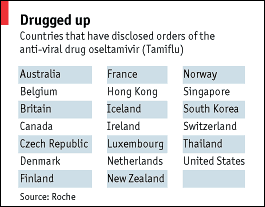
Via The Economist, Antiviral drugs could stamp out bird flu.
Well, perhaps we aren't all going to die afterall! On second thoughts, given what Roche is reporting, Indians may not be as safe as others on the planet. Anyone surprised?
The Sexed Up Uber-Equation
In Opinion Journal, James Seaton takes on Theory's Empire where today's academic theorists do not limit themselves to deconstructing, say, Jane Austen. They practice a broader sort of "theory" or, better, Theory. (One needs a capital letter to do justice to the ambition of the project.) Under the rubric of "cultural studies," theorists claim to possess the key to understanding all sorts of human activity, from crime to colonialism.
Here's a particularly hilarious discussion:
For most people outside the academy what is most striking--and most puzzling--about Theory is the prose in which it is couched. To take an example offered by contributor D.G. Myers: Homi Bhaba, a major theorist, refers to "the desperate effort to 'normalize' formally the disturbance of a discourse of splitting that violates the rational, enlightened claims of its enunciatory modality." (Whatever that may mean.) The theorist Luce Irigaray asks more clearly, though not more cogently: "Is E=MC² a sexed equation? Perhaps it is. Let us make the hypothesis that it is insofar as it privileges the speed of light over other speeds that are vitally necessary to us. What seems to me to indicate the possibly sexed nature of the equation is not directly its use by nuclear weapons, rather it is having privileged what goes the fastest."
Here's a particularly hilarious discussion:
For most people outside the academy what is most striking--and most puzzling--about Theory is the prose in which it is couched. To take an example offered by contributor D.G. Myers: Homi Bhaba, a major theorist, refers to "the desperate effort to 'normalize' formally the disturbance of a discourse of splitting that violates the rational, enlightened claims of its enunciatory modality." (Whatever that may mean.) The theorist Luce Irigaray asks more clearly, though not more cogently: "Is E=MC² a sexed equation? Perhaps it is. Let us make the hypothesis that it is insofar as it privileges the speed of light over other speeds that are vitally necessary to us. What seems to me to indicate the possibly sexed nature of the equation is not directly its use by nuclear weapons, rather it is having privileged what goes the fastest."
Thursday, August 04, 2005
Evil Echo
Via Christian Science Monitor, Al Qaeda to West: It's about policies.
Haven't we heard similar arguments before from "moderate" apologists for terror?
Haven't we heard similar arguments before from "moderate" apologists for terror?
Snort Me A River
Via BBC, Italian river 'full of cocaine' !!
Do we even dare imagine what 21st century Ganga jal is full of?
Do we even dare imagine what 21st century Ganga jal is full of?
A Welcome Murmur
Tonight, on American TV's public broadcasting newshour, we caught a really important conversation. On this four articulate Muslims Weigh Issues Of Islam and Violence.
A powerful excerpt:
ASRA NOMANI: We're up against a formidable enemy and we cannot dismiss that fact. What I've brought is a copy of the Koran, which comes from Saudi Arabia, you know, one of America's best friends, and the very first chapter says, "Guide us to the straight way, the way of those on whom you have bestowed your grace, not the way of those who have earned your anger." Then in parentheses is, "such as the Jews, and... nor those who went astray such as the Christians." So in parentheses -- so these are the interpretations that are added into the layers of Islam that are a manifestation of the Muslim world.
IMAM SHAKER ELSAYED: But they are not e text, you have to admit this much.
ASRA NOMANI: But this comes...
IMAM SHAKER ELSAYED: You have to admit this much, it's not the text.
ASRA NOMANI: This comes from the House of Saud.
IMAM SHAKER ELSAYED: But the House of Saud is not Islam.
ASRA NOMANI: But this is imported into America and this what is we have to face, and we have, while the law enforcement authorities are watching the borders and the boundaries, we have this ideological hatred spewing into America, into communities in England. I mean, right here I have a text also distributed at my mosque in West Virginia, that also takes the text and says that women can be beaten. And then we have sermons downloaded from Saudi Arabia that say that we should not be friends with the Jews and the Christians. And we've heard this thousands of times, and at the end of the day, this is what we're facing. I mean it's a machinery; it's Wahabiism incorporated, it's fundamentalism incorporated. It's beyond an individual; it's an entire system that we're up against.
A powerful excerpt:
ASRA NOMANI: We're up against a formidable enemy and we cannot dismiss that fact. What I've brought is a copy of the Koran, which comes from Saudi Arabia, you know, one of America's best friends, and the very first chapter says, "Guide us to the straight way, the way of those on whom you have bestowed your grace, not the way of those who have earned your anger." Then in parentheses is, "such as the Jews, and... nor those who went astray such as the Christians." So in parentheses -- so these are the interpretations that are added into the layers of Islam that are a manifestation of the Muslim world.
IMAM SHAKER ELSAYED: But they are not e text, you have to admit this much.
ASRA NOMANI: But this comes...
IMAM SHAKER ELSAYED: You have to admit this much, it's not the text.
ASRA NOMANI: This comes from the House of Saud.
IMAM SHAKER ELSAYED: But the House of Saud is not Islam.
ASRA NOMANI: But this is imported into America and this what is we have to face, and we have, while the law enforcement authorities are watching the borders and the boundaries, we have this ideological hatred spewing into America, into communities in England. I mean, right here I have a text also distributed at my mosque in West Virginia, that also takes the text and says that women can be beaten. And then we have sermons downloaded from Saudi Arabia that say that we should not be friends with the Jews and the Christians. And we've heard this thousands of times, and at the end of the day, this is what we're facing. I mean it's a machinery; it's Wahabiism incorporated, it's fundamentalism incorporated. It's beyond an individual; it's an entire system that we're up against.
Mercy
Via BBC, Death for India parliament raider.
Isn't our contempt for the bastard better served through our mercy, not through our violence? Shouldn't we be a society big enough to walk away from our valid instinct for vengeance, even for people as depraved as the convicted terrorist in this case?
We hope President Kalam will commute his sentence to life imprisonment.
Isn't our contempt for the bastard better served through our mercy, not through our violence? Shouldn't we be a society big enough to walk away from our valid instinct for vengeance, even for people as depraved as the convicted terrorist in this case?
We hope President Kalam will commute his sentence to life imprisonment.
Wednesday, August 03, 2005
A Real Dark Day In Iraq
We write this having strongly supported the purpose of the Iraq war.
Tonight, as India remains occupied with our continuing monsoon troubles and, believe it or not, cricket, bad tidings come from Iraq.
In the past couple days alone, a single US marines battalion alone has lost 20 young men there. Baghdad remains in chaos, the rest of Iraq even worse. There is little prospect of a sustainable political accord that might bring peace there, nor is there evidence of real progress in terms of improving day-to-day life for Iraqis.
None of this catastrophe diminishes the valid purpose of the war -- to take the battle to the very heart of Arabia, whose theocratic & secular tyrannies have (perhaps inadvertently) brought us the shadow of Al Qaeda. Since the men who lead these anachronistic tyrannies see no reason to reform, taking apart one of them (any one of them, the seemingly easiest one of them) made a great deal of sense.
The shocking chaos that's regrettably followed this valid purpose is a major problem because this suggests something the world did not know prior to this war: that even the mighty United States, who's spent blood & bullion in Iraq like they were water, cannot tame a country of merely 25 million.
The implications are staggering. Given how this is turning out, American people will not back another similar initiative any time soon. This blunts American power since other tyrants and evil doers know they have more flexibility than they realized they had prior to the Iraq war. Because America is the long pole holding up the globalization tent, this is bad news for all of us.
Also, consider this. If America could not impose its will & values in Iraq, can India ever do so in a much larger -- and much more dangerous -- Pakistan?
A lot of people on the left will now say, I told you so. They shouldn't exult too much. If America fails in Iraq and this creates a comfort zone for all manner of maniacal killers, their victims will be all of us -- whether we supported or opposed the Iraq war. In this dark hour, we are all in the same leaking boat. Besides, the left had no real idea on how to deal with the terrorism crisis except to argue (no, demand) that we deal with terrorism's so-called root causes -- i.e. concede defeat on political matters even though we think we are on the right side. The left has little credibility regardless of how dark this Iraq moment becomes.
So, here we are. Iraq is, alas, going to become a real test for American resolve & leadership. From what we know of America, every instinct in its soul would make it stand its ground and fight; but who can blame it for feeling real down when a week like this one comes along.
Tonight, as India remains occupied with our continuing monsoon troubles and, believe it or not, cricket, bad tidings come from Iraq.
In the past couple days alone, a single US marines battalion alone has lost 20 young men there. Baghdad remains in chaos, the rest of Iraq even worse. There is little prospect of a sustainable political accord that might bring peace there, nor is there evidence of real progress in terms of improving day-to-day life for Iraqis.
None of this catastrophe diminishes the valid purpose of the war -- to take the battle to the very heart of Arabia, whose theocratic & secular tyrannies have (perhaps inadvertently) brought us the shadow of Al Qaeda. Since the men who lead these anachronistic tyrannies see no reason to reform, taking apart one of them (any one of them, the seemingly easiest one of them) made a great deal of sense.
The shocking chaos that's regrettably followed this valid purpose is a major problem because this suggests something the world did not know prior to this war: that even the mighty United States, who's spent blood & bullion in Iraq like they were water, cannot tame a country of merely 25 million.
The implications are staggering. Given how this is turning out, American people will not back another similar initiative any time soon. This blunts American power since other tyrants and evil doers know they have more flexibility than they realized they had prior to the Iraq war. Because America is the long pole holding up the globalization tent, this is bad news for all of us.
Also, consider this. If America could not impose its will & values in Iraq, can India ever do so in a much larger -- and much more dangerous -- Pakistan?
A lot of people on the left will now say, I told you so. They shouldn't exult too much. If America fails in Iraq and this creates a comfort zone for all manner of maniacal killers, their victims will be all of us -- whether we supported or opposed the Iraq war. In this dark hour, we are all in the same leaking boat. Besides, the left had no real idea on how to deal with the terrorism crisis except to argue (no, demand) that we deal with terrorism's so-called root causes -- i.e. concede defeat on political matters even though we think we are on the right side. The left has little credibility regardless of how dark this Iraq moment becomes.
So, here we are. Iraq is, alas, going to become a real test for American resolve & leadership. From what we know of America, every instinct in its soul would make it stand its ground and fight; but who can blame it for feeling real down when a week like this one comes along.
Sunday, July 31, 2005
Song And Memory
For all his much-professed contempt for Bollywood, whenever this NRI blogger pines to be in an India state of mind, he reluctantly falls back on the songs he heard on Vividh Bharati growing up.
It isn't Indian food or Indian Express or even all the awesome Indian blogs he reads daily but Kishore Kumar, Mohammad Rafi, and sometime Asha ji, who transports his mind back home!!
This is not fair -- evil Bollywood has infected even the idyllic memory of our homeland. Darn!!!
It isn't Indian food or Indian Express or even all the awesome Indian blogs he reads daily but Kishore Kumar, Mohammad Rafi, and sometime Asha ji, who transports his mind back home!!
This is not fair -- evil Bollywood has infected even the idyllic memory of our homeland. Darn!!!
Cheapening Lives To Reduce Their Cost
This past week has been one of multiple Indian calamities.
Hundreds lie dead of cloudburst; tens of thousands more stand marooned from their already wretched lives. Offshore, three hundred hard-toiling oilmen, digging wealth out from under the sea, found themselves facing death. Even the privileged found little respite from nature's wrath & --paraphrasing our favorite songwriter, Leonard Cohen -- the widowhood of our government.
Still, our desensitized lives went on undisturbed. Some even asked what was special about Mumbai's sorrow?
While such cynicism is without doubt unseemly, there's a perverse point here somewhere. Afterall, don't multitudes die perennially in cloudbursts & famishment, accidents & gunfire, dirty water & dirtier syringes, botched abortions & dowry fires, Kalahandi & Kashmir, tsunami & terrorism, and God only knows how many other hellfires in this our India? On this continent-sized canvas of Indian horror, Mumbai's sorrow were, alas, really nothing new.
Bad things happen everywhere; what's remarkable is that, in India, people die in bunches and suffer obscenely when bad things happen. This should bother us a lot; it rarely does.
The reason it doesn't is because we all understand that, given our limited resources, our culture takes shortcuts in all things; we have become such experts in cutting corners & trimming costs that those who don't are mocked. If we were to plan our lives the right way with due consideration for human safety and quality-of-life (that is really tested in extreme circumstances such as what's unfolding in Mumbai), we'd simply not be able to afford all the things we want in our lives. In effect, our culture trades-off a certain quantum and quality of human lives in return for our being able to go on with our (consequently endangered) lives -- we cheapen our lives so as to reduce their cost.
Let's stipulate also that we're all sufficiently cynical that none of this bothers us very much -- except when the sewers flow back into our own neat little make-believe sanctuaries. If the reader isn't grossed out by this mystifying chalta-hai attitude, there's an interesting question that emerges from this that he/she might wish to consider.
How does anyone know that the horrors we witness everyday are consistent with the trade-offs we signed up to? This is to say if, in a perfect world, no one were to die from a cloudburst such as we witnessed last week, what should our expectation be given the trade-offs we've presumably signed up to? Is it 500 or is it 1000? Is there any benchmark for the wretchedness we've presumably accepted in the trade-off?
This is not an academic question. Consider this for instance. It's relatively easy to judge the performance of a government, corporation, and individual in places (like America) where (generally speaking) no such trade-offs are in place. There exist quantifiable metrics on people's expectations for all manner of services and things that constitute life. There is a well-developed tort system that imposes heavy cost on those who fail their performance metrics -- thus, a strong economic discipline keeps everyone in line. There's no way to take short-cuts because, in the long run, people who consequently get hurt end up extracting significantly more punitive damages than the accrued cost if the short-cut had not been taken.
In contrast a culture like ours, which trades-off human safety for cost, has no benchmarks whatsoever to calibrate our expectations apriori (because our metrics were compromised when someone, somewhere elected to cut corners without telling the rest of us what corners they cut) and there is no meaningful ex post facto remedy mechanism where civil and/or criminal burdens can be levied on whoever is shown responsible for the short-cut.
So, because we don't know if it was 500 people expected to die of the cloudburst given the (predictable) structural conditions they were in -- in which case someone should be made to pay since over 800 actually died -- or was it 3000 people expected to die -- in which case someone should be given a medal -- we read news accounts, blog about them, then move on. Everyone who's responsible for the unfathomable and unmeasured horror has a get-out-of-jail-free card because the rest of us are all in the dark.
Is there a solution? Well, for one, if we had a robust tort system, it'd be a good start. Maybe we can't avert dying in bunches but we can impose really harsh cost on whoever is responsible. This will surely increase the cost of our lives but it will enhance their value as well.
Perhaps Mumbai will take a lead in this. We hope the people of the city will sue for serious damage and extract a precedent-setting punitive award from the government. Sure, it isn't all the government's fault, but they are at least partly to blame and we know their address. So, Mumbai, how about serving your government a tsunami of summons? Don't settle for the pathetic compensation packages they will offer. Beat them in court and show India a new way of doing things.
Ring the bells that still can ring
Forget your perfect offering
There is a crack, a crack in everything
That's how the light gets in. Leonard Cohen
Hundreds lie dead of cloudburst; tens of thousands more stand marooned from their already wretched lives. Offshore, three hundred hard-toiling oilmen, digging wealth out from under the sea, found themselves facing death. Even the privileged found little respite from nature's wrath & --paraphrasing our favorite songwriter, Leonard Cohen -- the widowhood of our government.
Still, our desensitized lives went on undisturbed. Some even asked what was special about Mumbai's sorrow?
While such cynicism is without doubt unseemly, there's a perverse point here somewhere. Afterall, don't multitudes die perennially in cloudbursts & famishment, accidents & gunfire, dirty water & dirtier syringes, botched abortions & dowry fires, Kalahandi & Kashmir, tsunami & terrorism, and God only knows how many other hellfires in this our India? On this continent-sized canvas of Indian horror, Mumbai's sorrow were, alas, really nothing new.
Bad things happen everywhere; what's remarkable is that, in India, people die in bunches and suffer obscenely when bad things happen. This should bother us a lot; it rarely does.
The reason it doesn't is because we all understand that, given our limited resources, our culture takes shortcuts in all things; we have become such experts in cutting corners & trimming costs that those who don't are mocked. If we were to plan our lives the right way with due consideration for human safety and quality-of-life (that is really tested in extreme circumstances such as what's unfolding in Mumbai), we'd simply not be able to afford all the things we want in our lives. In effect, our culture trades-off a certain quantum and quality of human lives in return for our being able to go on with our (consequently endangered) lives -- we cheapen our lives so as to reduce their cost.
Let's stipulate also that we're all sufficiently cynical that none of this bothers us very much -- except when the sewers flow back into our own neat little make-believe sanctuaries. If the reader isn't grossed out by this mystifying chalta-hai attitude, there's an interesting question that emerges from this that he/she might wish to consider.
How does anyone know that the horrors we witness everyday are consistent with the trade-offs we signed up to? This is to say if, in a perfect world, no one were to die from a cloudburst such as we witnessed last week, what should our expectation be given the trade-offs we've presumably signed up to? Is it 500 or is it 1000? Is there any benchmark for the wretchedness we've presumably accepted in the trade-off?
This is not an academic question. Consider this for instance. It's relatively easy to judge the performance of a government, corporation, and individual in places (like America) where (generally speaking) no such trade-offs are in place. There exist quantifiable metrics on people's expectations for all manner of services and things that constitute life. There is a well-developed tort system that imposes heavy cost on those who fail their performance metrics -- thus, a strong economic discipline keeps everyone in line. There's no way to take short-cuts because, in the long run, people who consequently get hurt end up extracting significantly more punitive damages than the accrued cost if the short-cut had not been taken.
In contrast a culture like ours, which trades-off human safety for cost, has no benchmarks whatsoever to calibrate our expectations apriori (because our metrics were compromised when someone, somewhere elected to cut corners without telling the rest of us what corners they cut) and there is no meaningful ex post facto remedy mechanism where civil and/or criminal burdens can be levied on whoever is shown responsible for the short-cut.
So, because we don't know if it was 500 people expected to die of the cloudburst given the (predictable) structural conditions they were in -- in which case someone should be made to pay since over 800 actually died -- or was it 3000 people expected to die -- in which case someone should be given a medal -- we read news accounts, blog about them, then move on. Everyone who's responsible for the unfathomable and unmeasured horror has a get-out-of-jail-free card because the rest of us are all in the dark.
Is there a solution? Well, for one, if we had a robust tort system, it'd be a good start. Maybe we can't avert dying in bunches but we can impose really harsh cost on whoever is responsible. This will surely increase the cost of our lives but it will enhance their value as well.
Perhaps Mumbai will take a lead in this. We hope the people of the city will sue for serious damage and extract a precedent-setting punitive award from the government. Sure, it isn't all the government's fault, but they are at least partly to blame and we know their address. So, Mumbai, how about serving your government a tsunami of summons? Don't settle for the pathetic compensation packages they will offer. Beat them in court and show India a new way of doing things.
Ring the bells that still can ring
Forget your perfect offering
There is a crack, a crack in everything
That's how the light gets in. Leonard Cohen
Choosing One's Enemies
General Musharraf, for all his much-vaunted commando-style tactical skills, is not at all smart in who he chooses as his enemies.
Why else would he alienate this columnist with a really powerful soapbox?
Why else would he alienate this columnist with a really powerful soapbox?
Saturday, July 30, 2005
Puzzling Attitude
Gaurav Sabnis is puzzled by the attitude of some Indians, and why not?
Shouldn't all Indians stand in awe of the happenin' citizens of Mumbai who've taken a few on the chin this week but still stood their ground? Too bad this is apparently not the case.
Shouldn't all Indians stand in awe of the happenin' citizens of Mumbai who've taken a few on the chin this week but still stood their ground? Too bad this is apparently not the case.
NRI Voting Rights
Via Rediff, NRIs may get voting rights. [NRI here means those who hold the Indian passport.]
This is great news, one we've long championed and directly lobbied for. Kudos to the Government.
This is great news, one we've long championed and directly lobbied for. Kudos to the Government.
Wednesday, July 27, 2005
Water And Fire
 Photo courtesy: NDTV
This blogger, once an oilfield engineer himself, mourns bitterly our brave oilmen lost today. T S Eliot's eternally brilliant poem Little Gidding comes to mind:
Water and fire shall rot
The marred foundations we forgot,
Of sanctuary and choir.
This is the death of water and fire.
Water Water Everywhere
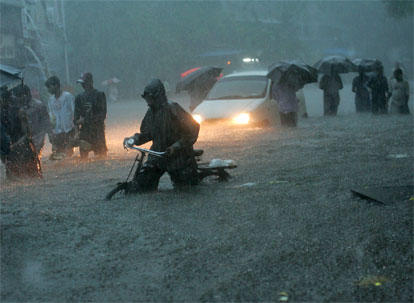
Photo courtesy: Midday News
Also read: Streets like rivers at India Uncut.
We wish Mumbai the very best in wading through this deluge.
Whither ARF?
Stratfor has the following to say on the suddenly unpopular ARF:
Chinese Foreign Minister Li Zhaoxing will not attend the ASEAN Regional Forum (ARF) in Laos on July 29. Li follows U.S. Secretary of State Condoleezza Rice, Japanese Foreign Minister Nobutaka Machimura and Indian Foreign Minister Natwar Singh in pulling out of this year's ARF. As ASEAN pushes toward the creation of the East Asia Summit, the limits and redundancies of its other regional initiatives are growing more apparent.
Chinese Foreign Minister Li Zhaoxing will not attend the ASEAN Regional Forum (ARF) in Laos on July 29. Li follows U.S. Secretary of State Condoleezza Rice, Japanese Foreign Minister Nobutaka Machimura and Indian Foreign Minister Natwar Singh in pulling out of this year's ARF. As ASEAN pushes toward the creation of the East Asia Summit, the limits and redundancies of its other regional initiatives are growing more apparent.

The Gurgaon Riots
Nitin correctly suggests that these horrific riots should be a trigger for broad labor reform.
Our concern, however, is with the conduct of the police. After much reflection, we believe the police has much to answer for. There's no excuse whatsoever for police lapses in professionalism, even in circumstances of extreme provocation (as they existed here). Society gives police the right to wield guns & batons; in exchange, we expect at least a minimum standard of professional conduct. Police losing their cool hardly meets this expectation.
There's, thus, a sound basis here for legislative challenges to the governing party in Haryana.
But, beyond all this lies a greater question. Why are police in India frequently so unprofessional and brutal in their tactics?
The answer, regretfully, lies with we, the people. We've rarely made good policing an issue in our elections.
In early 2004, this blogger had a chance to discuss manifesto issues with a leading parliamentarian assigned the task by his party. We noted that more Indians are victims of violence outside Kashmir everyday than are victims of terrorism there. Yet, India spends a ton more defending Kashmir than defending Indians elsewhere in the country.
This is not to say we disfavor the Kashmir investment. As our readers know, we have a very hardline position on that subject. But, we are also interested in what goes on elsewhere in India. Here, good people are terrified of criminals and, even worse, terrified of the police. This is absurd.
Now, this state of affairs is a natural consequence of our failure to invest in the police. Our police are deprived of resources, technology, training, moral support, political independence, and social respect. Is it any wonder the police are as brutal as they are?
Therefore, we gamely argued, law-and-order should be made a campaign issue with substantial new investments in upgrading our police infrastructure being the core proposal. Needless to say, we were ignored. As Gurgaon has abundantly made clear, India needs to reverse this famine if we are to avert future Gurgaons.
Our concern, however, is with the conduct of the police. After much reflection, we believe the police has much to answer for. There's no excuse whatsoever for police lapses in professionalism, even in circumstances of extreme provocation (as they existed here). Society gives police the right to wield guns & batons; in exchange, we expect at least a minimum standard of professional conduct. Police losing their cool hardly meets this expectation.
There's, thus, a sound basis here for legislative challenges to the governing party in Haryana.
But, beyond all this lies a greater question. Why are police in India frequently so unprofessional and brutal in their tactics?
The answer, regretfully, lies with we, the people. We've rarely made good policing an issue in our elections.
In early 2004, this blogger had a chance to discuss manifesto issues with a leading parliamentarian assigned the task by his party. We noted that more Indians are victims of violence outside Kashmir everyday than are victims of terrorism there. Yet, India spends a ton more defending Kashmir than defending Indians elsewhere in the country.
This is not to say we disfavor the Kashmir investment. As our readers know, we have a very hardline position on that subject. But, we are also interested in what goes on elsewhere in India. Here, good people are terrified of criminals and, even worse, terrified of the police. This is absurd.
Now, this state of affairs is a natural consequence of our failure to invest in the police. Our police are deprived of resources, technology, training, moral support, political independence, and social respect. Is it any wonder the police are as brutal as they are?
Therefore, we gamely argued, law-and-order should be made a campaign issue with substantial new investments in upgrading our police infrastructure being the core proposal. Needless to say, we were ignored. As Gurgaon has abundantly made clear, India needs to reverse this famine if we are to avert future Gurgaons.
Tuesday, July 26, 2005
Drunk On Art
Via BBC, £42,500 bottle of water snatched!!!
American-born artist Wayne Hill said the bottle was clearly a work of art.
He said: "It looked like an ordinary bottle of water. But it was on a plinth, labelled, described and in the programme of the whole festival."
The piece, entitled Weapon of Mass Destruction, vanished half way through the festival. Mr Hill fears the bottle was taken and then drunk.
"It was there and then it was gone," he said.
American-born artist Wayne Hill said the bottle was clearly a work of art.
He said: "It looked like an ordinary bottle of water. But it was on a plinth, labelled, described and in the programme of the whole festival."
The piece, entitled Weapon of Mass Destruction, vanished half way through the festival. Mr Hill fears the bottle was taken and then drunk.
"It was there and then it was gone," he said.
Monday, July 25, 2005
Want To Scream?
Via Drudge Report, 700 injured in clash between Honda workers and police in India.
Via India Uncut, Barbarism at the gate.
Via India Uncut, Barbarism at the gate.
Asra Nomani
Last night, Book TV had Akbar Ahmed interviewing Asra Nomani.
Dr. Ahmed is the Ibn Khaldun Chair of Islamic Studies at American University in Washington. Ms. Nomani, a former Wall Street Journal reporter, is the Indian-American author of Standing Alone in Mecca.
The brave Ms. Nomani has created waves by her entirely valid demand that she, and fellow Muslim women, be treated at par with men at her Morgantown mosque. For this straightforward demand, she now faces excommunication from the mosque founded by her own father!
Dr. Ahmed is a polite man, and Ms. Nomani very courteous, but the interview was quite disturbing. In the course of the interview, the moderate Dr. Ahmed dismissed any talk of Islamic reform (since Muslims have been given God's final word by His Messenger). He prefers the word renaissance, instead. Fair enough. But, given the challenges facing moderate Islam, this kind of hair-splitting over words is staggering. Why is Dr. Ahmed (who young people look up to) wasting time on precise definitions of next steps when he should be emphasizing the obvious direction the Ummah needs to move in?
Dr. Ahmed also -- gently & indirectly -- chided Ms. Nomani for her tactics which have brought unwelcome media attention to her community.
His recommendation to her was to find a way to handle her concerns within the community. He suggested that mosques are democratic institutions where even the Imam is elected; so, Ms. Nomani might be better served trying that democratic process to seek equality at her own mosque!
Frankly, it is her community that ought to be ashamed that, living in America, it still holds on to antediluvian inequality of women. Powerful Muslim voices like Ms. Nomani do not need to submit to their community's anti-reform leadership. It is the community that needs to adapt to 21st century American Muslim modernity represented by the brave people like Ms. Nomani. Why is it even acceptable that there's a chance she can be excommunicated simply for asking to be equal? If all Muslims are equal (as she proudly notes) in Mecca, why not then in Morgantown? Why isn't Dr. Ahmed dispensing his erudition to the neanderthals there?
We had long looked up to Dr. Ahmed. After this interview, regretfully, he's fallen quite a few notches in our esteem.
Dr. Ahmed is the Ibn Khaldun Chair of Islamic Studies at American University in Washington. Ms. Nomani, a former Wall Street Journal reporter, is the Indian-American author of Standing Alone in Mecca.
The brave Ms. Nomani has created waves by her entirely valid demand that she, and fellow Muslim women, be treated at par with men at her Morgantown mosque. For this straightforward demand, she now faces excommunication from the mosque founded by her own father!
Dr. Ahmed is a polite man, and Ms. Nomani very courteous, but the interview was quite disturbing. In the course of the interview, the moderate Dr. Ahmed dismissed any talk of Islamic reform (since Muslims have been given God's final word by His Messenger). He prefers the word renaissance, instead. Fair enough. But, given the challenges facing moderate Islam, this kind of hair-splitting over words is staggering. Why is Dr. Ahmed (who young people look up to) wasting time on precise definitions of next steps when he should be emphasizing the obvious direction the Ummah needs to move in?
Dr. Ahmed also -- gently & indirectly -- chided Ms. Nomani for her tactics which have brought unwelcome media attention to her community.
His recommendation to her was to find a way to handle her concerns within the community. He suggested that mosques are democratic institutions where even the Imam is elected; so, Ms. Nomani might be better served trying that democratic process to seek equality at her own mosque!
Frankly, it is her community that ought to be ashamed that, living in America, it still holds on to antediluvian inequality of women. Powerful Muslim voices like Ms. Nomani do not need to submit to their community's anti-reform leadership. It is the community that needs to adapt to 21st century American Muslim modernity represented by the brave people like Ms. Nomani. Why is it even acceptable that there's a chance she can be excommunicated simply for asking to be equal? If all Muslims are equal (as she proudly notes) in Mecca, why not then in Morgantown? Why isn't Dr. Ahmed dispensing his erudition to the neanderthals there?
We had long looked up to Dr. Ahmed. After this interview, regretfully, he's fallen quite a few notches in our esteem.
Another Police Disgrace
Via BBC, Inmate's 50 years without trial.
If there were justice in our world, someone should have to pay a heavy price for this colossal injustice. Unfortunately, that's unlikely to happen in our India.
If there were justice in our world, someone should have to pay a heavy price for this colossal injustice. Unfortunately, that's unlikely to happen in our India.
Two Poems From Bengal
This weekend, we read Roger Depue's book Between Good and Evil. Mr. Depue, founder & retired leader of FBI's famed Behavioral Science Unit, has seen much evil in his life and his book is a meditation on its very nature. [Thomas Harris, author of The Silence of the Lambs, was guided by Mr. Depue as he constructed Hannibal Lector.]
At the end of his book, Mr. Depue cites Tagore to celebrate the marvelous wonder that is ordinary human existence:
When I think of this end of my moments
The barrier of the moment breaks
And I see by the light of death
Your world with its careless treasures.
This weekend, a Sri Lankan friend wrote us the following Ramprasad poem:
Mother! My boat is sinking, here in the ocean of this world;
Fiercely the hurricane of delusion rages on every side!
Clumsy is my helmsman, the mind; stubborn my six oarsmen, the passions!
Into a pitiless wind
I sailed my boat, and now it is sinking.
Split is the rudder of devotion; tattered is the sail of faith;
Into my boat the waters are pouring! Tell me what shall I do?
For with my failing eyes, alas! nothing but darkness do I see.
Here in the waves I will swim,
Oh mother, and cling to the raft of Thy Name.
At the end of his book, Mr. Depue cites Tagore to celebrate the marvelous wonder that is ordinary human existence:
When I think of this end of my moments
The barrier of the moment breaks
And I see by the light of death
Your world with its careless treasures.
This weekend, a Sri Lankan friend wrote us the following Ramprasad poem:
Mother! My boat is sinking, here in the ocean of this world;
Fiercely the hurricane of delusion rages on every side!
Clumsy is my helmsman, the mind; stubborn my six oarsmen, the passions!
Into a pitiless wind
I sailed my boat, and now it is sinking.
Split is the rudder of devotion; tattered is the sail of faith;
Into my boat the waters are pouring! Tell me what shall I do?
For with my failing eyes, alas! nothing but darkness do I see.
Here in the waves I will swim,
Oh mother, and cling to the raft of Thy Name.
Sunday, July 24, 2005
Terrorism
Via Washington Post, Mona Eltahawy's brave & wise column After London, Tough Questions for Muslims. After posing her tough questions, she concludes:
I raise these questions because London might have done it for me, but I'm not done with Islam. The clerics and the terrorists will not take it away from me. God belongs to me, too.
Bravo!
I raise these questions because London might have done it for me, but I'm not done with Islam. The clerics and the terrorists will not take it away from me. God belongs to me, too.
Bravo!
Pakistan
Here is an excerpt from a discussion on Pakistan's future among our friends. We thought we'd post our views here.
We're not very sanguine about the (Indo-Pak) peace process ; the strong Pakistani military -- with a soothing, anglophone General at helm -- keeps the civilized world from dealing with the monster that Pakistan is, because it's much too tempting to buy the mirage these dictators have to sell.
Given this, we (meaning the civilized, democratic world) might actually be better off absent Musharraf (or another similar General), because then we would have no lazy excuse to evade our responsibility of emaciating the Pakistani monster -- a bellicose terror state, a nuclear proliferator, a modern day colonialist (witness the fate of Afghanistan & PoK), and a proselytizer of radical jihad some of whose global children "secure" their futures through suicide bombings (ours, in contrast, build global supply chains).
This does not need Iraq-style military action. All it needs is a weaker Pakistani military, which will then allow the inherent contradictions of that artificial state to manifest themselves (admittedly, India, too has some of the same contradictions, but our pluralist democracy & sustainable economic growth are great glues; Pakistan has none of this). Baluchistan is in near-revolt (again!), Pashtuns are kin to their siblings across the Durand line (whose shelf life has now expired!), and Sindh is being starved of water by its Punjabi cousins; then there's also the Mohajir issue (Altaf Hussain having already said the partition was a blunder!). Paraphrasing T S Eliot: Pakistan is like dead water & dead sand, contending for the upper hand!!!
Our task (i.e. of the civilized world) is to deploy our resources to contain this necessary conflict, so that it burns on a manageable fuse, but it burns alright (kinda' like a controlled burn for forest fires). In the end, hopefully, we'll have 3-4 smaller & more pliable states -- where we can, via persuasion or imposition, require modernity & democracy.
We're not very sanguine about the (Indo-Pak) peace process ; the strong Pakistani military -- with a soothing, anglophone General at helm -- keeps the civilized world from dealing with the monster that Pakistan is, because it's much too tempting to buy the mirage these dictators have to sell.
Given this, we (meaning the civilized, democratic world) might actually be better off absent Musharraf (or another similar General), because then we would have no lazy excuse to evade our responsibility of emaciating the Pakistani monster -- a bellicose terror state, a nuclear proliferator, a modern day colonialist (witness the fate of Afghanistan & PoK), and a proselytizer of radical jihad some of whose global children "secure" their futures through suicide bombings (ours, in contrast, build global supply chains).
This does not need Iraq-style military action. All it needs is a weaker Pakistani military, which will then allow the inherent contradictions of that artificial state to manifest themselves (admittedly, India, too has some of the same contradictions, but our pluralist democracy & sustainable economic growth are great glues; Pakistan has none of this). Baluchistan is in near-revolt (again!), Pashtuns are kin to their siblings across the Durand line (whose shelf life has now expired!), and Sindh is being starved of water by its Punjabi cousins; then there's also the Mohajir issue (Altaf Hussain having already said the partition was a blunder!). Paraphrasing T S Eliot: Pakistan is like dead water & dead sand, contending for the upper hand!!!
Our task (i.e. of the civilized world) is to deploy our resources to contain this necessary conflict, so that it burns on a manageable fuse, but it burns alright (kinda' like a controlled burn for forest fires). In the end, hopefully, we'll have 3-4 smaller & more pliable states -- where we can, via persuasion or imposition, require modernity & democracy.
Nuclear India
Joseph Cirincione was on the terrific C-SPAN this morning discussing the Indo-US nuclear agreement.
He is an able advocate for non-proliferation, hence opposed the agreement. No surprise there. The key point he made was that there's always a conflict between those who focus on state-to-state diplomacy and those (like him) who focus on functional diplomacy (e.g., non-proliferation). In case of India, the former appear to have the upper hand.
The most important part of the discussion were the viewer calls. Of all the viewers who called in, only one (a Pakistani-Canadian) opposed the Indo-US agreement. One viewer was confused why the controversy existed given that India is already a nuclear power. Another thought that India is a key ally in the war against Islamist terrorism. Yet another felt that India is key to containing China.
This pro-India reaction of the American people is a very welcome development. They are wisely reciprocating India's own warmth for Americans. Also, because this warmth is not limited to the elites in Washington & Delhi, it has all the signs of strengthening over time.
He is an able advocate for non-proliferation, hence opposed the agreement. No surprise there. The key point he made was that there's always a conflict between those who focus on state-to-state diplomacy and those (like him) who focus on functional diplomacy (e.g., non-proliferation). In case of India, the former appear to have the upper hand.
The most important part of the discussion were the viewer calls. Of all the viewers who called in, only one (a Pakistani-Canadian) opposed the Indo-US agreement. One viewer was confused why the controversy existed given that India is already a nuclear power. Another thought that India is a key ally in the war against Islamist terrorism. Yet another felt that India is key to containing China.
This pro-India reaction of the American people is a very welcome development. They are wisely reciprocating India's own warmth for Americans. Also, because this warmth is not limited to the elites in Washington & Delhi, it has all the signs of strengthening over time.
Saturday, July 23, 2005
Friday, July 22, 2005
Terrorism
In National Review Online, the military historian Victor Davis Hanson argues that to counter terrorism it is time to relearn the lessons of the cold war.
We are generally aligned with Dr. Hanson's thinking and this essay too is generally sensible, although not particularly original. What caught our eye is this odd conclusion Dr. Hanson has drawn:
Meanwhile an odd thing happened. It turns out that the jihadists were cowards and bullies, and thus selective in their targets of hatred. A billion Chinese were left alone by radical Islam — even though the Chinese were secularists and mostly godless, as well as ruthless to their own Uighur Muslim minorities. Had bin Laden issued a fatwa against Beijing and slammed an airliner into a skyscraper in Shanghai, there is no telling what a nuclear China might have done.
India too got mostly a pass, other than the occasional murdering by Pakistani zealots. Yet India makes no effort to apologize to Muslims. When extremists occasionally riot and kill, they usually cease quickly before the response of a much more unpredictable angry populace.
So far global jihad avoids two billion Indians and Chinese, despite the fact that their countries are far tougher on Muslims than is the United States or Europe. In other words, the Islamicists target those whom they think they can intimidate and blackmail.
Holy mother of God! Does Dr. Hanson seriously thinks India has been given a pass on terrorism? He should read US State Department reports on the subject. But even worse, he thinks India has escaped catastrophic terror because, in effect, of the deterrence value of things like the horrible Gujarat retaliation of 2002. We are stunned that such blots on India can now be cited as examples of what may be an effective strategy to counter terrorism.
This blog has taken a very hardline posture on terror, perhaps even more so than Dr. Hanson, but we cannot agree with his spectacularly off-base characterization of India's experience with terrorism. That a scholar such as he can lapse into such careless thinking is, alas, a sign of frayed nerves in the West -- this is not a good sign if we are to win this war on terror.
We are generally aligned with Dr. Hanson's thinking and this essay too is generally sensible, although not particularly original. What caught our eye is this odd conclusion Dr. Hanson has drawn:
Meanwhile an odd thing happened. It turns out that the jihadists were cowards and bullies, and thus selective in their targets of hatred. A billion Chinese were left alone by radical Islam — even though the Chinese were secularists and mostly godless, as well as ruthless to their own Uighur Muslim minorities. Had bin Laden issued a fatwa against Beijing and slammed an airliner into a skyscraper in Shanghai, there is no telling what a nuclear China might have done.
India too got mostly a pass, other than the occasional murdering by Pakistani zealots. Yet India makes no effort to apologize to Muslims. When extremists occasionally riot and kill, they usually cease quickly before the response of a much more unpredictable angry populace.
So far global jihad avoids two billion Indians and Chinese, despite the fact that their countries are far tougher on Muslims than is the United States or Europe. In other words, the Islamicists target those whom they think they can intimidate and blackmail.
Holy mother of God! Does Dr. Hanson seriously thinks India has been given a pass on terrorism? He should read US State Department reports on the subject. But even worse, he thinks India has escaped catastrophic terror because, in effect, of the deterrence value of things like the horrible Gujarat retaliation of 2002. We are stunned that such blots on India can now be cited as examples of what may be an effective strategy to counter terrorism.
This blog has taken a very hardline posture on terror, perhaps even more so than Dr. Hanson, but we cannot agree with his spectacularly off-base characterization of India's experience with terrorism. That a scholar such as he can lapse into such careless thinking is, alas, a sign of frayed nerves in the West -- this is not a good sign if we are to win this war on terror.
Thursday, July 21, 2005
Silence Of A Blogger
Why has Reformist Muslim (a London-based blogger) not blogged since 7/7?
Sensible voices like RM's are much needed at this time of grave peril.
Sensible voices like RM's are much needed at this time of grave peril.
Neoconservatism
Via Opinion Journal, neoconservative Charles Krauthammer reflects on the triumph and maturing of the neoconservative revolution. This is a very insightful essay. A must read.
One choice excerpt:
Another important sign of the maturing of neoconservative foreign policy is that it is no longer tethered to its own ideological history and paternity. The current practitioners of neoconservative foreign policy are George W. Bush, Dick Cheney, Condoleezza Rice and Donald Rumsfeld. They have no history in the movement, and before 9/11 had little affinity to or affiliation with it.
The fathers of neoconservatism are former liberals or leftists. Today, its chief proponents, to judge by their history, are former realists. Ms. Rice, for example, was a disciple of Brent Scowcroft; Mr. Cheney served as secretary of defense in the first Bush administration. September 11 changed all of that. It changed the world, and changed our understanding of the world. As neoconservatism seemed to offer the most plausible explanation of the new reality and the most compelling and active response to it, many realists were brought to acknowledge the poverty of realism--not just the futility but the danger of a foreign policy centered on the illusion of stability and equilibrium. These realists, newly mugged by reality, have given weight to neoconservatism, making it more diverse and, given the newcomers' past experience, more mature.
One choice excerpt:
Another important sign of the maturing of neoconservative foreign policy is that it is no longer tethered to its own ideological history and paternity. The current practitioners of neoconservative foreign policy are George W. Bush, Dick Cheney, Condoleezza Rice and Donald Rumsfeld. They have no history in the movement, and before 9/11 had little affinity to or affiliation with it.
The fathers of neoconservatism are former liberals or leftists. Today, its chief proponents, to judge by their history, are former realists. Ms. Rice, for example, was a disciple of Brent Scowcroft; Mr. Cheney served as secretary of defense in the first Bush administration. September 11 changed all of that. It changed the world, and changed our understanding of the world. As neoconservatism seemed to offer the most plausible explanation of the new reality and the most compelling and active response to it, many realists were brought to acknowledge the poverty of realism--not just the futility but the danger of a foreign policy centered on the illusion of stability and equilibrium. These realists, newly mugged by reality, have given weight to neoconservatism, making it more diverse and, given the newcomers' past experience, more mature.
A Week For The History Books
It's only Thursday, yet this week has seen more portentous developments than its fair share. Just consider these headlines whose implications could ripple through our lives over decades:
Welcome to the nuclear club
US to allies: Don't make a fuss of Indo-US ties
IAEA's ElBaradei hails US-India accord on N-energy
Saudi ambassador to US Bandar bin Sultan resigns
China Severs Its Currency's Peg to Dollar
John Roberts Chosen by Bush for US Supreme Court, CNN Says
Welcome to the nuclear club
US to allies: Don't make a fuss of Indo-US ties
IAEA's ElBaradei hails US-India accord on N-energy
Saudi ambassador to US Bandar bin Sultan resigns
China Severs Its Currency's Peg to Dollar
John Roberts Chosen by Bush for US Supreme Court, CNN Says
Wednesday, July 20, 2005
The Loony General
Via South Asia Tribune, Musharraf Asks US to Silence His US-based Critics!!
And this fella' is the frontline ally in our war against terror? Does he even know how to spell the word FREEDOM?
And this fella' is the frontline ally in our war against terror? Does he even know how to spell the word FREEDOM?
On Liberty
While we need to carefully think before discussing the complex edges of liberty -- e.g., euthanasia & drugs -- we can easily support Spencer Tunick's liberty to pursue what's obviously art.
Khalid Ansari's antediluvian prudery on this matter is simultaneously pathetic and amusing.
[Links courtesy: India Uncut]
Khalid Ansari's antediluvian prudery on this matter is simultaneously pathetic and amusing.
[Links courtesy: India Uncut]
Karzai And Blair
For those who missed it live yesterday, here's the transcript of an extraordinary joint press conference by President Karzai and Prime Minister Blair.
This is a must read on terrorism, especially for the root-cause crowd. Choice excerpts follow.
President Karzai: Look, I come from a country where extremists were the government, I come from a country where terrorism was ruling us, we were slaves to them before the world came and freed us. When they were in power they were killing people that only said we need a bit more freedom, they were killing people that wanted their young daughter to go to school, they were beating a man on the street, in front of his wife, in front of the public in a bazaar place, because his wife happened to have white shoes. There was no press, there was no radio, there was no television, there was no speech, they were suffocating life, and the only thing that they were doing was using Afghan infrastructure, the airports, the air bases, to train pilots and to prepare for blowing up the twin towers, and if you had not stopped them by 2001 when that incident occurred, in the three years that followed on you would have had many more of your buildings and buildings elsewhere in the world blown up by planes like that. And you would have had, out of the suffering that they were causing to the Afghan people, a human misery not seen in the history of mankind. Therefore people like that, how can they claim to kill and yet ask to speak, through our systems. Come on! I would like them to come and confront me in public, I would like to talk to them in public. They are cowards, they are ashamed, they will not come to confront you.
These guys, if they are working for a cause and if they are trying to justify that now by arguments related to Iraq or whatever, why were they killing in 1995, 1996, 1997, 2000, innocent children in Afghanistan?
We were the poorest of the Muslim world, we were the ones that had defeated communism and we were the best Muslims in fighting communism. Why would they go and burn the vineyard of a poor Afghan widow whose husband had died in fighting communism, the Jihad, why would they kill her, burn her orchard or spear her baby? So, there is no link to any argument that they offer, they are simply merchants of death.
Prime Minister Blair: Well they will use any issue, and before Iraq it was Afghanistan, before Iraq and Afghanistan it was the Palestinian issue, or support for the existence of Israel, not incidentally Israel and Palestine living side by side in peace because that is what we support, but support for the existence of Israel. Before all of those things it was America, just America, what it does, what it is. They will always have a reason for that, and yes they will use any issue to recruit people, they will recruit people over Iraq, they were recruited over Afghanistan, they were recruited over Palestine. But where does that argument lead you? If you are not careful you get inside their twisted logic, and the fact is what they are doing in Iraq and Afghanistan is utterly wrong, and what we are doing, leave aside whether you think it was right or wrong, the conflict in Iraq, leave aside that, what is happening now, today, and has been for the last two years in Iraq is a UN backed process to support Iraqi people having their democracy. Do they want it? Yes. They showed it when they came out in their millions to vote. Who is trying to stop them? The same terrorist ideology. And that is why, you know people can debate about this issue between the links and what are the superficial causes or symptoms, the fundamental causes I am afraid I think are a lot deeper and we need to address those.
And you know there is a kind of insidious way of the way that this is looked at where people say yes we entirely abhor the methods of these terrorists, but nonetheless we sort of understand what they are saying about American foreign policy, or Iraq, or Afghanistan or Palestine. No, let us be absolutely clear about this, the legitimate voice of Afghanistan is the man beside me who was elected, not al Queda or the Taliban. The legitimate voice of Iraq is the Prime Minister who was appointed after a democratic election, it is not the Jihadists who are killing innocent people in Iraq. The legitimate voice of the Palestinians is Mahmoud Abbas, the President elected by the Palestinians, it is not terrorists.
And therefore I think when people talk about the links between whether it is Iraq, or Afghanistan, or Palestine in what has happened, of course these people will use these things as an excuse, but let's be absolutely clear, if it wasn't that it would be something else, and nothing, but nothing, justifies what they are doing.
This is a must read on terrorism, especially for the root-cause crowd. Choice excerpts follow.
President Karzai: Look, I come from a country where extremists were the government, I come from a country where terrorism was ruling us, we were slaves to them before the world came and freed us. When they were in power they were killing people that only said we need a bit more freedom, they were killing people that wanted their young daughter to go to school, they were beating a man on the street, in front of his wife, in front of the public in a bazaar place, because his wife happened to have white shoes. There was no press, there was no radio, there was no television, there was no speech, they were suffocating life, and the only thing that they were doing was using Afghan infrastructure, the airports, the air bases, to train pilots and to prepare for blowing up the twin towers, and if you had not stopped them by 2001 when that incident occurred, in the three years that followed on you would have had many more of your buildings and buildings elsewhere in the world blown up by planes like that. And you would have had, out of the suffering that they were causing to the Afghan people, a human misery not seen in the history of mankind. Therefore people like that, how can they claim to kill and yet ask to speak, through our systems. Come on! I would like them to come and confront me in public, I would like to talk to them in public. They are cowards, they are ashamed, they will not come to confront you.
These guys, if they are working for a cause and if they are trying to justify that now by arguments related to Iraq or whatever, why were they killing in 1995, 1996, 1997, 2000, innocent children in Afghanistan?
We were the poorest of the Muslim world, we were the ones that had defeated communism and we were the best Muslims in fighting communism. Why would they go and burn the vineyard of a poor Afghan widow whose husband had died in fighting communism, the Jihad, why would they kill her, burn her orchard or spear her baby? So, there is no link to any argument that they offer, they are simply merchants of death.
Prime Minister Blair: Well they will use any issue, and before Iraq it was Afghanistan, before Iraq and Afghanistan it was the Palestinian issue, or support for the existence of Israel, not incidentally Israel and Palestine living side by side in peace because that is what we support, but support for the existence of Israel. Before all of those things it was America, just America, what it does, what it is. They will always have a reason for that, and yes they will use any issue to recruit people, they will recruit people over Iraq, they were recruited over Afghanistan, they were recruited over Palestine. But where does that argument lead you? If you are not careful you get inside their twisted logic, and the fact is what they are doing in Iraq and Afghanistan is utterly wrong, and what we are doing, leave aside whether you think it was right or wrong, the conflict in Iraq, leave aside that, what is happening now, today, and has been for the last two years in Iraq is a UN backed process to support Iraqi people having their democracy. Do they want it? Yes. They showed it when they came out in their millions to vote. Who is trying to stop them? The same terrorist ideology. And that is why, you know people can debate about this issue between the links and what are the superficial causes or symptoms, the fundamental causes I am afraid I think are a lot deeper and we need to address those.
And you know there is a kind of insidious way of the way that this is looked at where people say yes we entirely abhor the methods of these terrorists, but nonetheless we sort of understand what they are saying about American foreign policy, or Iraq, or Afghanistan or Palestine. No, let us be absolutely clear about this, the legitimate voice of Afghanistan is the man beside me who was elected, not al Queda or the Taliban. The legitimate voice of Iraq is the Prime Minister who was appointed after a democratic election, it is not the Jihadists who are killing innocent people in Iraq. The legitimate voice of the Palestinians is Mahmoud Abbas, the President elected by the Palestinians, it is not terrorists.
And therefore I think when people talk about the links between whether it is Iraq, or Afghanistan, or Palestine in what has happened, of course these people will use these things as an excuse, but let's be absolutely clear, if it wasn't that it would be something else, and nothing, but nothing, justifies what they are doing.
Nuclear Club
Washington Post, a very influential and generally pro-India voice in the US, weighs in on the just signed Indo-US nuclear agreement. In its sober and sophisticated editorial, A New Nuclear Era, the Post lays out the opportunities and challenges emerging from this agreement.
This editorial is a good indication of the mixed attitudes of even pro-India Americans. Clearly, we have a lot of work ahead of us.
This editorial is a good indication of the mixed attitudes of even pro-India Americans. Clearly, we have a lot of work ahead of us.
Tuesday, July 19, 2005
Stress Reduction
Via Pittsburgh Post Gazette, Belly fat may be body's way of coping with stress.
Via BBC, Sea view helps cut stress levels.
Does this mean then that Maximum City denizens are leaner in the gut than, say, those in India's Capital City?!
Via BBC, Sea view helps cut stress levels.
Does this mean then that Maximum City denizens are leaner in the gut than, say, those in India's Capital City?!
Unsound Judgment
Via NDTV, SC bans use of loudspeakers after 10 in night.
While the outcome is clearly welcome, the use of the court to achieve this is dubious. Where does India's constitution bar freedom of expression beyond 10 PM? Since it does not, the court has no authority to make this ruling out of thin air -- which is what it has done here.
Make no mistake. This is an erosion of democracy since our judiciary is not elected by the people. Some day we'll all pay for granting our judiciary such unchecked and, in our humble view, unconstitutional authority. As we've observed before, Courts Shouldn't Legislate.
While the outcome is clearly welcome, the use of the court to achieve this is dubious. Where does India's constitution bar freedom of expression beyond 10 PM? Since it does not, the court has no authority to make this ruling out of thin air -- which is what it has done here.
Make no mistake. This is an erosion of democracy since our judiciary is not elected by the people. Some day we'll all pay for granting our judiciary such unchecked and, in our humble view, unconstitutional authority. As we've observed before, Courts Shouldn't Legislate.
Libertarianism
We concur with Amit that there's a great deal of intersection between our notion of secular-right and libertarianism.
Both believe in limiting government to only such areas whose scale requires that it alone can do the heavy lifting. Because individual freedoms are the fundamental reality of the universe, power has legitimacy only if it flows from free choice of individuals -- and is subservient to their needs, not vice versa.
Indeed our secularism emerges from precisely this expectation of small government. We aren't secular because we deny the validity of faith, nor driven by Western motives to separate church & state. We believe in a secular state because we see no value in having (a usually inept) government meddle around in something so fundamental as people's faith. To the extent the government is best kept away from faith, there is consequently no reason to inject faith in politics (since, ideally, the politician has no power to grant favors on the basis of faith).
Having said all this, we are less sanguine about the fundamentalism of some libertarians. For example, we are perfectly happy to dilute some civil liberties (on the edges & carefully) so that terrorism and terror exhorters are snuffed out. Unyielding battles on abstract principles of civil liberties when our lives are at stake are silly. Too many libertarians lose the forest for the trees on such issues.
We also dispute the bogus denunciation of democracy by some libertarians.
Bottom line, there's sufficient common ground (a very practical standard) for secular-right and libertarian Indians to collaborate on. This is a very good thing.
Both believe in limiting government to only such areas whose scale requires that it alone can do the heavy lifting. Because individual freedoms are the fundamental reality of the universe, power has legitimacy only if it flows from free choice of individuals -- and is subservient to their needs, not vice versa.
Indeed our secularism emerges from precisely this expectation of small government. We aren't secular because we deny the validity of faith, nor driven by Western motives to separate church & state. We believe in a secular state because we see no value in having (a usually inept) government meddle around in something so fundamental as people's faith. To the extent the government is best kept away from faith, there is consequently no reason to inject faith in politics (since, ideally, the politician has no power to grant favors on the basis of faith).
Having said all this, we are less sanguine about the fundamentalism of some libertarians. For example, we are perfectly happy to dilute some civil liberties (on the edges & carefully) so that terrorism and terror exhorters are snuffed out. Unyielding battles on abstract principles of civil liberties when our lives are at stake are silly. Too many libertarians lose the forest for the trees on such issues.
We also dispute the bogus denunciation of democracy by some libertarians.
Bottom line, there's sufficient common ground (a very practical standard) for secular-right and libertarian Indians to collaborate on. This is a very good thing.
Security Council
Via Rediff, India's SC bid must wait for UN reform, says Bush.
This is not a surprise, not a big deal, and should not dismay Indians. The Indo-US relationship is now a vital cog in the globalized world order -- getting this fact recognized in Washington is a real big achievement for Dr. Singh.
Just look at this headline in the conservative Economist: Welcome to the nuclear club. To which we say, very happy to be here!!
This is not a surprise, not a big deal, and should not dismay Indians. The Indo-US relationship is now a vital cog in the globalized world order -- getting this fact recognized in Washington is a real big achievement for Dr. Singh.
Just look at this headline in the conservative Economist: Welcome to the nuclear club. To which we say, very happy to be here!!
Monday, July 18, 2005
Empowering Muslim Women
Via Andrew Sullivan, here are Johann Hari's interesting prescriptions for Islamic reformation: empower Muslim women & cut dependence on middle-eastern oil.
We strongly endorse the former. On the latter, we can't see any immediate way to accomplish the laudable goal --with India & China coming on-line, the demand for this oil will go up, not down. It's not clear why we have to sacrifice our prosperity for a broader Islamic reformation.
We strongly endorse the former. On the latter, we can't see any immediate way to accomplish the laudable goal --with India & China coming on-line, the demand for this oil will go up, not down. It's not clear why we have to sacrifice our prosperity for a broader Islamic reformation.
Sunday, July 17, 2005
I Am Become Death, Destroyer Of Worlds
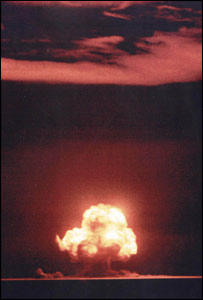
Yet Another Terror Apologist
The following excerpt is from a Humayun Gauhar column in the Pakistani daily, Daily Nation. That such vile nonsense finds publication in Pakistan, circa 2005, should tell us enough about the state of public discourse there.
Telltale signs of Mossad’s pernicious presence in the 9/11 attacks remain, as they do in the Turkish synagogue bombing. But they are all glossed over, and we are ridiculed for being conspiracy theorists. There is such a thing as agent provocateurs who inveigle frustrated, impressionable and not very intelligent minds into believing that they are actually Al Qaeda when they may actually be Mossad, into carrying out these attacks. There is great wisdom in some old sayings, and I leave you with one of them. Who benefits from the crime? A truthful answer to the question will lead you to the wellspring of this evil.
If the British people really want to prevent the consequences of evil from visiting them again, they should force their government to do what Spain did after the Madrid train bombing - get out of Iraq and detach their country from America’s perfidious foreign policy. It only brings harm to you. Remember you are no longer a superpower. Don’t try to be one. There is no great merit in being a superpower anyway, for superpowers have regularly blazed across the pages of history for a while and then died from their own crimes and contradictions. History bears witness to this in every single instance.
Telltale signs of Mossad’s pernicious presence in the 9/11 attacks remain, as they do in the Turkish synagogue bombing. But they are all glossed over, and we are ridiculed for being conspiracy theorists. There is such a thing as agent provocateurs who inveigle frustrated, impressionable and not very intelligent minds into believing that they are actually Al Qaeda when they may actually be Mossad, into carrying out these attacks. There is great wisdom in some old sayings, and I leave you with one of them. Who benefits from the crime? A truthful answer to the question will lead you to the wellspring of this evil.
If the British people really want to prevent the consequences of evil from visiting them again, they should force their government to do what Spain did after the Madrid train bombing - get out of Iraq and detach their country from America’s perfidious foreign policy. It only brings harm to you. Remember you are no longer a superpower. Don’t try to be one. There is no great merit in being a superpower anyway, for superpowers have regularly blazed across the pages of history for a while and then died from their own crimes and contradictions. History bears witness to this in every single instance.
HIV In India
This morning we saw a touching HBO documentary titled Pandemic: Facing AIDS. The episode centered around Nagaraj & Bhanu, both HIV+ and awaiting the birth of their child.
The documentary's value is in putting real faces to the crisis. Kudos.
The documentary's value is in putting real faces to the crisis. Kudos.
Answering A Contemptible Charge
Rezwan responded to our recent post Vinod Mehta On Terrorism with an astonishing diatribe where he accuses us ("you people") of generalizing our hatred against all the Muslims, thereby dishonoring the struggles of these (anti-radical) majority against the radicals.
He also suggests that by taking a hardline view of Islamist terror (which he denies exists, wow!), we risk letting the backlash grow, thereby placing all the browns in trouble.
The last suggestion is profoundly racist. We don't see ourselves part of any "brown ummah" requiring us to hide from the truth out of a "solidarity of fear" with the communities where recent Islamist terrorists have come from.
Rezwan's ridiculous accusation of our generalizing our hatred against all Muslims comes from our unequivocal rejection of the root-cause arguments -- which too many moderate Muslims and their liberal allies are, alas, too quick to offer. Those who accuse us of hatred should take their words back because we have rejected the root-cause logic not just in the case of Islamist terror, but also in the case of Hindutva terror (in Gujarat). As evidence we offer this January post (written upon the release of Justice Banerjee report absolving the Muslims accused of the Godhara arson which spawned the subsequent mass Muslim lynchings at Hindu hands). We wrote:
We think this obsession with cause & effect -- or better put, root cause & effect -- is wrong. In this context, even if there was perfidy by some Muslim hoodlums (a claim Justice Banerjee disputes), we still cannot find any justification for what followed. No root cause can ever justify deliberate murder of innocent human beings.
We stand by the logic of these words and they apply to all people. This root-cause rationalization for utter depravity has already gone too far. It's time to call it for what it is: a rationalization for evil.
It's one thing to debate an issue, but to accuse us of hatred is beyond the pale. How dare somebody think they can level such a disgraceful charge and not expect a harsh response? How dare they?
He also suggests that by taking a hardline view of Islamist terror (which he denies exists, wow!), we risk letting the backlash grow, thereby placing all the browns in trouble.
The last suggestion is profoundly racist. We don't see ourselves part of any "brown ummah" requiring us to hide from the truth out of a "solidarity of fear" with the communities where recent Islamist terrorists have come from.
Rezwan's ridiculous accusation of our generalizing our hatred against all Muslims comes from our unequivocal rejection of the root-cause arguments -- which too many moderate Muslims and their liberal allies are, alas, too quick to offer. Those who accuse us of hatred should take their words back because we have rejected the root-cause logic not just in the case of Islamist terror, but also in the case of Hindutva terror (in Gujarat). As evidence we offer this January post (written upon the release of Justice Banerjee report absolving the Muslims accused of the Godhara arson which spawned the subsequent mass Muslim lynchings at Hindu hands). We wrote:
We think this obsession with cause & effect -- or better put, root cause & effect -- is wrong. In this context, even if there was perfidy by some Muslim hoodlums (a claim Justice Banerjee disputes), we still cannot find any justification for what followed. No root cause can ever justify deliberate murder of innocent human beings.
We stand by the logic of these words and they apply to all people. This root-cause rationalization for utter depravity has already gone too far. It's time to call it for what it is: a rationalization for evil.
It's one thing to debate an issue, but to accuse us of hatred is beyond the pale. How dare somebody think they can level such a disgraceful charge and not expect a harsh response? How dare they?
Saturday, July 16, 2005
Vinod Mehta On Terrorism
We find ourselves frequently in opposition to Vinod Mehta's left-liberal views. This is why we were surprised by the following sensible words he has written in Outlook:
.. what one would dearly like to see is more Muslim countries and more Muslim voices unequivocally confronting bin Laden ideologically. We are constantly reminded that the overwhelming majority of Muslims find the Islam propagated by bin Laden repugnant; Islam's reputation as a strict but tolerant faith has been badly damaged by this "medieval savage". If there is a backlash against innocent Muslims in Britain, who is to blame? It is only when traditional Islam defeats this pernicious variant that Mr bin Laden can be isolated. Sadly, those moderate voices are few and far between. The argument that Al Qaeda is not a Muslim but a global problem will not wash because Mr bin Laden is not giving Christians or Hindus or Jews a bad name, but Muslims.
While on the subject, let me confess I am greatly disappointed that more Muslims in India did not speak out against the Imrana fatwa issued by the "wise men" of Deoband.
And while we are on this topic, let's please quit this annoying habit of changing the subject whenever Islamist terrorism is brought up. Other horrors attributable to non-Muslims are hardly the point. If terrorism is repugnant (as most sensible people agree), then why give it the legitimacy of any possible political justification? As long as moderate Muslims (& their naive liberal allies) keep offering up these rationalizations for Islamist terrorism -- thereby rendering their condemnations equivocal, we're afraid there's not going to be much progress at all.
.. what one would dearly like to see is more Muslim countries and more Muslim voices unequivocally confronting bin Laden ideologically. We are constantly reminded that the overwhelming majority of Muslims find the Islam propagated by bin Laden repugnant; Islam's reputation as a strict but tolerant faith has been badly damaged by this "medieval savage". If there is a backlash against innocent Muslims in Britain, who is to blame? It is only when traditional Islam defeats this pernicious variant that Mr bin Laden can be isolated. Sadly, those moderate voices are few and far between. The argument that Al Qaeda is not a Muslim but a global problem will not wash because Mr bin Laden is not giving Christians or Hindus or Jews a bad name, but Muslims.
While on the subject, let me confess I am greatly disappointed that more Muslims in India did not speak out against the Imrana fatwa issued by the "wise men" of Deoband.
And while we are on this topic, let's please quit this annoying habit of changing the subject whenever Islamist terrorism is brought up. Other horrors attributable to non-Muslims are hardly the point. If terrorism is repugnant (as most sensible people agree), then why give it the legitimacy of any possible political justification? As long as moderate Muslims (& their naive liberal allies) keep offering up these rationalizations for Islamist terrorism -- thereby rendering their condemnations equivocal, we're afraid there's not going to be much progress at all.
Subscribe to:
Posts (Atom)